
.svg)
When the market stalls, strategy wins
In a market where buyers have real leverage for the first time in years, the difference between a home that sells in 7 days and one that expires at 90 comes down to one thing: the work done before it ever hits MLS. That's the conversation I start with every seller.

Watch video
.svg)
Thank you! Your submission has been received!
Oops! Something went wrong while submitting the form.
10
Years of Experience
+50
Neighbourhoods
+200
Ratings & Reviews
4.9★
Google Rating
The 2026 Toronto Seller Reality
Most Toronto sellers are losing sleep over the same questions.
Toronto's market is still price-sensitive, but supply tightened noticeably in August. GTA sales were down 2.1% year over year, while new listings fell 14.1% and active listings dropped 11.3%. Prices remain below last year's levels, but with fewer homes available, sellers who price and present properly may face less competition heading into the fall market.
Toronto Market Snapshot
August 2026 | Source: TRREB
Average Selling Price
$
941.800
↓ 7.4% YOY
Days on Market
28
days
↑ from 21 days YOY
Sale-to-List Ratio
97.2
%
↓ from 100.3% YOY
Months of Supply
4.3
Balanced market overall
Active Listings
21,596
SNLR
34.9
%
Market Direction
Tightening
Here's what sellers are actually worried about right now
These aren't irrational fears. They're what the data looks like right now. And they're exactly why sellers who choose the right agent at the start make a 5–6 figure difference compared to those who don't.
Pricing wrong
"Am I going to lose $80,000 by pricing too high and sitting?"
Market timing
"Should I wait for rates to drop or will I miss the window?"
Getting ignored
"Why are some listings getting showings and mine isn't?"
Stale listing
"What happens if my home expires? Does that follow me?"
Geopolitical noise
"With tariffs and job uncertainty, are buyers even out there?"
Carrying costs
"Every month I wait costs me mortgage, condo fees, and taxes."
Neighbourhood gaps
"My neighbour's home sold. Why isn't mine?"
Hidden costs
"How much do I actually walk away with after commission and adjustments?"
Why some Toronto homes don't sell and others get multiple offers on the same street
Same neighbourhood. Same month. Same price range. One home sells in 9 days with three competing offers. Another expires after 60 days with two price reductions. The difference is almost never the home itself.
The Home That Sits
Priced to a seller's emotional number, not the buyer's current threshold
Launched with no pre-list strategy — straight to MLS, cold
Photography shot on a cloudy Tuesday with a wide-angle lens
No staging — buyers can't picture the space
Listed during a competitive week with 8 comparable properties
Zero follow-up system for showing feedback
No digital presence outside the MLS aggregators
Negotiation strategy: wait and hope
The Home That Sells
Priced using a hyperlocal CMA that accounts for this month's buyer psychology
Pre-launched to a targeted buyer network before hitting MLS
4K HDR photography + cinematic video shot at golden hour
Staged to signal space, light, and lifestyle
Launch timing engineered for maximum early-week momentum
Real-time feedback loop informs daily strategy adjustments
Active buyer targeting on Google, Meta, and YouTube before Day 1
Negotiation strategy: control the process, protect your price
From the first call to the sold sign.
here's exactly how this works.
Most agents list your home. I prepare a campaign. Here are the six phases
of every listing I take on.
of every listing I take on.
.svg)
STEP 1
Pre-Listing Audit
Before we talk price, we talk positioning. I walk the property with a buyer's eye — not a seller's. I identify what needs to change, what can stay, and what will cost you money if ignored. You get a written prep list with estimated ROI on each item so you can decide what's worth doing.
STEP 2
Pricing Architecture
This isn't a CMA printout from 90 days ago. I build your pricing strategy around the current competitive set — what's active right now, what just sold last week, and most importantly, what's expiring and why. In this market, pricing $15,000 too high costs you $40,000 at the end.
STEP 3
Production Week
4K HDR photography. Cinematic lifestyle video. Floor plans. Virtual staging if needed. Matterport 3D tour. Every listing gets the same production level. Buyers decide in 8 seconds whether to book a showing — the visual package is the first negotiation.
STEP 4
Launch Strategy
Your home goes live on a Tuesday or Wednesday — never Friday. Pre-launch digital ads target qualified buyers before Day 1. The BrokerBay system books showings instantly, 24/7. The first 7–14 days are the highest-leverage window in any listing. We don't waste a single hour of it.
STEP 5
Active Market Management
I don't list and disappear. You get showing feedback within 24 hours of every visit. Weekly market check-ins. Competitor monitoring. If the strategy needs to shift, we shift. You will always know exactly where you stand and why.
STEP 6
Offer Management & Close
When offers come in, this is where strategy becomes money. I have negotiated hundreds of deals. I know where buyers have flexibility, where they don't, and how to run a multiple-offer situation or a conditional negotiation to protect your final number.
Every listing. No tiers. No upgrades to unlock.
In today's market, there is no "basic" version of a successful listing. Every home I list receives the same level of preparation, production, and pursuit.
Pre-Listing
Written property preparation audit
Hyperlocal pricing analysis (current week's data)
Staging consultation
Pre-listing digital audience building

Production
Professional 4K HDR photography
Cinematic lifestyle video
Digital floor plans with measurements
Virtual staging (where applicable)
Matterport 3D interactive tour
Personal listing website (dedicated URL, conversion-optimized)
Marketing & Distribution
MLS + all major aggregator syndication
Google Search + Display ad campaigns
Meta (Instagram/Facebook) retargeting
YouTube video ad promotion
Sponsored Google Maps placement
Email distribution to buyer agent network
Listing Management
BrokerBay instant showing scheduling (24/7)
Real-time automated showing feedback
Weekly market position report
QR-code print materials for showings and open houses
Digital open house engagement system
Negotiation & Close
Offer review and analysis
Multiple-offer management
Conditions and clause guidance (with your lawyer)
Transaction coordination to close
Elevated production package
For vacant properties, luxury homes, or properties requiring architectural staging or 3D rendering, an elevated production package is available. Ask about this in your strategy call.
Toronto doesn't have one market. It has fifty.
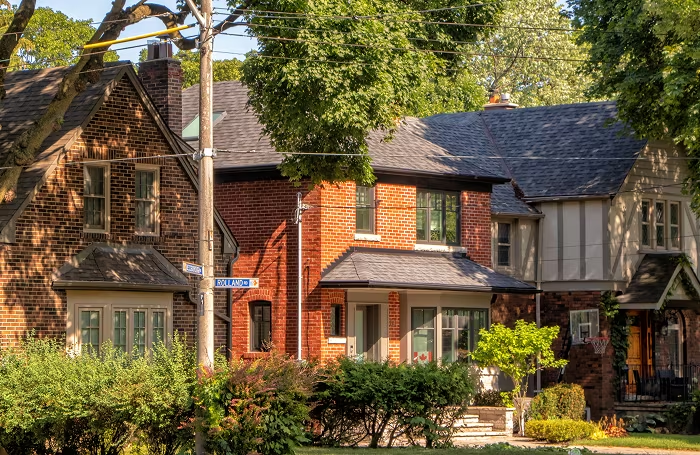
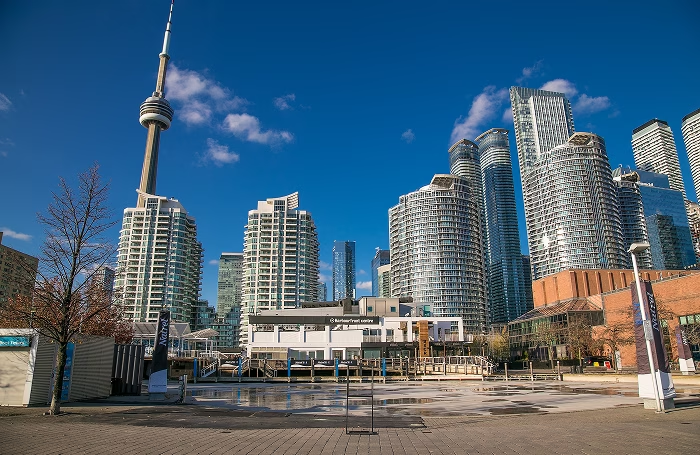
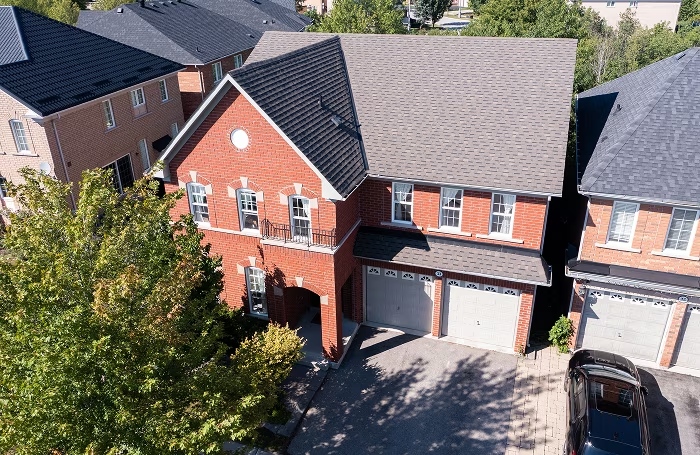
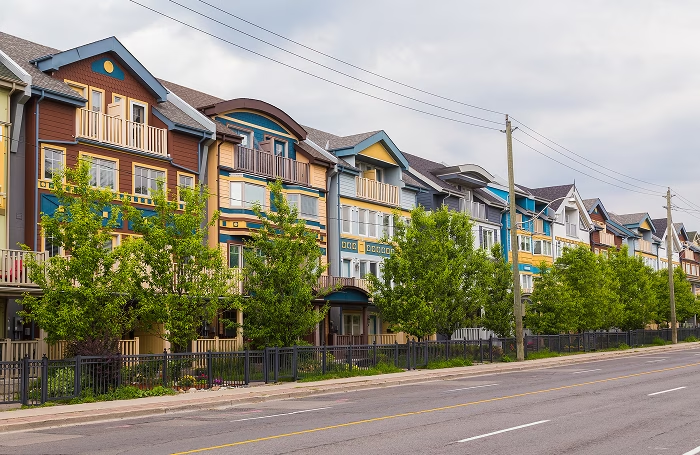
A condo in Liberty Village and a semi in East York are not playing by the same rules right now. Neighbourhood-level knowledge is the difference between accurate pricing and a stale listing. I work across 50+ Toronto neighbourhoods with on-the-ground insight into which streets are moving and which aren't.
.svg)

.avif)
Real Stories from Families I’ve Helped Home
Real experiences from homeowners who found clarity, peace of mind,
and exceptional results through a personal and dedicated approach to real estate.
and exceptional results through a personal and dedicated approach to real estate.
.svg)
Excellent on Google
4.9

(198)
Working with Shen Walji was an absolute pleasure from start to finish. He helped me downsize from my 2,600-square-foot detached home in East Credit, Mississauga to a beautiful penthouse apartment where I can enjoy a stress-free lifestyle with every amenity I could want.
Shen guided me patiently through a very challenging real estate market, always keeping me informed and focused on the big picture. He followed up diligently after every showing and open house and never lost momentum in getting my property sold. His negotiation skills were sharp, and he fought hard to protect my best interests every step of the way.
He also introduced me to an excellent Mississauga real estate lawyer and an incredible mover who even helped me pack my contents. Shen truly goes beyond expectations to make the transition seamless.
Whether you’re buying or selling in East Credit, Erin Mills, Streetsville, or Churchill Meadows, Shen is a true professional who knows these Mississauga neighbourhoods inside and out. He also excels at helping first-time home buyers and newcomers to Canada navigate their real estate journey with confidence.
I highly recommend him to anyone looking for a dedicated, experienced, and trustworthy realtor.
R
Robert Bell
Shen helped me sell my house, and dealing with him was a pleasure. He was very informative and supportive. Communication was great. Legitimately like working with friend. Highly recommend his service
P
Paul Toews
I live out of town and was selling a condo in Toronto, so needed a full service agent who could arrange, clear out, cleaning and redecorating etc. Shen did a fine job assisting with this in record time - all done in one week. We conferred on asking price and were in close agreement. In the first few days of listing, we had numerous visits; after 4 days, we had 3 offers. Shen very effectively negotiated with the high bidder, and we ended up with an offer over asking with no conditions and a quick close. In the current condo market, this was an outstanding result.
J
Julian B
Shen guided me for over a year until I was ready to sell my home in the Clairlea-Birchmount neighbourhood of Scarborough.
His consistent check-ins kept me on track and prepared for the real estate market while I focused on my career.
Shen’s deep knowledge of Scarborough and Greater Toronto Area real estate, combined with his hands-on marketing strategy, perfect timing, and extensive boots-on-the-ground experience, made all the difference.
He helped me set a smart listing price, which led to my home selling in multiple offers for over $125K above asking on the very first day on the market.
From pricing to navigating the complex legal process, Shen handled everything with professionalism, transparency, and clear communication.
If you are looking to buy or sell a home in Scarborough, Clairlea-Birchmount, or anywhere in the GTA, I highly recommend Shen as a top real estate agent who truly puts his clients first.
W
Wendy Gaboury
What is your home worth in today's Toronto market?
Not last year's market. Not the number your neighbour got in 2022. Today's number specific to your property, your street, your neighbourhood.
Oops! Something went wrong while submitting the form.
.avif)
Questions Toronto Sellers Are Asking Right Now
Should I sell my Toronto home now or wait?
The honest answer is that waiting carries a real cost. Every month you hold a property, you're paying mortgage interest, property tax, utilities, and condo fees if applicable — often $2,500 to $5,000+ per month. While prices have softened in 2026, the spring market has shown modest stabilization, with buyers re-engaging after a slow winter. Waiting for a "recovery" that no analyst is projecting before late 2026 or 2027 may cost more than the additional price appreciation you'd gain. The better question is: with the right strategy and pricing, can I sell well now? For most sellers in freehold properties, the answer is yes.
Why is my home not selling in Toronto?
There are four common reasons a Toronto listing stalls: overpricing relative to the current competitive set (not last year's prices), insufficient or poor-quality visual presentation, a weak or absent digital marketing strategy, and launching at the wrong time relative to competing inventory. In today's market, buyers are comparing 10–15 listings before booking a showing. If your home doesn't stand out in the first 8 seconds of a Realtor.ca scroll, it doesn't get a showing. Stale listings — those sitting more than 30 days — also create buyer suspicion that something is wrong, driving further price reductions. Getting the launch right is everything.
How long does it take to sell a house in Toronto in 2026?
The average days on market for freehold homes in Toronto in early 2026 is approximately 22–28 days depending on the neighbourhood and property type. Condos are taking longer — often 35–50 days — given the elevated supply in the downtown core. Well-priced, well-presented freehold properties in high-demand east-end and west-end neighbourhoods continue to see brisk activity and, in some cases, competing offers. The gap between a properly launched home and an improperly launched one is significant: some homes sell in 7 days, others expire after 90. The difference is nearly always strategy, not the property.
Are Toronto home prices still dropping in 2026?
GTA benchmark prices fell approximately 7.4% year-over-year as of early 2026, with the average sale price around $1,017,000. Royal LePage has projected a further modest decline of approximately 4.5% by Q4 2026. However, price performance is highly neighbourhood and property-type specific. Freehold properties in established east-end and west-end Toronto neighbourhoods have shown more resilience than downtown condos, where supply remains elevated. If you need to sell in 2026, the strategy isn't to wait for prices to recover — it's to price accurately for where the market is today and execute a launch that creates competition.
How do I price my home correctly in Toronto's 2026 market?
Pricing in 2026 requires a forward-looking, buyer-psychology-aware approach — not just a backward-looking CMA. That means analyzing what's currently listed (your competition), what's recently sold (in the last 14–21 days, not 90), what's expiring (and why), and where buyers' financing constraints actually place their ceiling. Pricing $10,000–$20,000 too high in a buyer's market often costs sellers $30,000–$60,000 at the end — either through price reductions, longer carrying costs, or both. My pricing architecture is built around current buyer behaviour, not historical optimism.
What happens if my home doesn't sell in Toronto?
A listing that expires carries real consequences. It signals to buyers and agents that the home was overpriced or had problems — even if neither is true. Re-listing after an expiry almost always requires a price reduction to reset perception, and you lose the critical "first week" momentum that typically drives the best offers. If your listing is approaching 30 days with limited showing activity, it's time to reassess the pricing and marketing strategy immediately, not wait until expiry. This is why pre-launch preparation and realistic pricing matter so much — preventing a stale listing is far easier than recovering from one.
Do I need to stage my home before selling in Toronto?
In a market where buyers are being selective, staging is not optional — it's pricing strategy. Staged homes consistently sell faster and for more money than vacant or poorly furnished ones. Buyers make emotional decisions and then rationalize them logically. Staging tells buyers how to feel about a space. Virtual staging (digitally furnished photography) is a cost-effective option for vacant properties. Full physical staging is worth considering for any property priced above $900,000 where the ROI on a $2,000–$5,000 staging investment can be $15,000–$30,000 in final sale price. I provide a staging consultation as part of every listing.
Should I renovate before listing my Toronto home?
Usually no — not for major renovations. Buyers rarely pay dollar-for-dollar for renovations, and in a soft market, they often don't pay full value at all. Targeted cosmetic improvements — fresh paint, updated light fixtures, decluttering, deep cleaning, curb appeal — typically deliver the best ROI for a fraction of the cost. Where my pre-listing audit helps: identifying the 3–5 items that will meaningfully affect buyer perception versus the items that won't move the needle. Not every repair is worth doing, and some renovations actively narrow your buyer pool.
How much does it cost to sell a house in Toronto?
The costs of selling a Toronto home typically include: real estate commission (buyer's and seller's agent combined, negotiated with your listing agent), lawyer fees ($1,500–$2,500), potential mortgage discharge or prepayment penalty (varies significantly), staging and pre-listing preparation costs, and any adjustments negotiated in the offer. As a ballpark, sellers should model 3–5% of the sale price in total transaction costs. I walk every seller through a net proceeds estimate before listing so there are no surprises at closing.
Which Toronto neighbourhoods are selling fastest right now?
As of spring 2026, freehold properties in established east-end neighbourhoods (Leslieville, Riverdale, East York, The Beaches) and select west-end areas (Roncesvalles, Bloor West Village, The Junction) continue to see relatively healthy demand compared to the downtown condo market. North Toronto and Midtown freehold homes in the $900K–$1.3M range are also holding up in areas with strong school catchments. The downtown condo market faces the most headwinds, with elevated supply and hesitant investors. Neighbourhood-level data matters more than GTA-wide averages — a block-level analysis is part of every strategy consultation.
How do tariffs and economic uncertainty affect Toronto home sales?
Trade and geopolitical uncertainty have a real psychological effect on buyer confidence. When buyers feel economically uncertain — about their jobs, their portfolios, or the broader economy — they pull back from large financial commitments. This is why some properties are sitting even at fair prices: the buyer pool has shrunk. That doesn't mean homes can't sell — it means the buyers who remain are more analytical, more conditional, and more price-sensitive. A listing strategy in this environment must work harder to attract, engage, and convert the buyers who are in the market. Passive MLS listings get ignored. Active buyer targeting gets results.
What is a stale listing and how do I avoid one?
A stale listing is one that has been on the market long enough that buyers begin to assume something is wrong with it — even if nothing is. In Toronto's current market, "stale" perception typically sets in around 21–30 days without an accepted offer. Once a listing is perceived as stale, price reductions become necessary to re-engage buyer interest, and even then, buyers often submit below-ask offers because of the perceived stigma. Avoiding a stale listing starts with accurate pricing, strong visual presentation, and active marketing in the first week. The launch window is the highest-leverage moment in any listing — it cannot be recovered once lost.
How do I choose the right listing agent in Toronto?
Ask for: a written pre-listing strategy (not just a CMA), a list of every property they've listed in the past 12 months and what happened to each one (sold price vs list price, days on market, any expirations), their marketing plan with specifics (not just "social media"), and references from sellers in your neighbourhood and price range. Be cautious of agents who tell you what you want to hear about price without showing you the data. In a buyer's market, an agent who flatters your price expectations is not doing you any favors. The right agent will be honest about where the market is, even when it's uncomfortable.
What is Shen's sell-to-list ratio and days on market track record?
I have maintained a 100% sale success rate — meaning every property listed has sold, with no expired listings and no failed deals. This is notable in a market where listings frequently expire due to overpricing or poor strategy. Specific neighbourhood, property type, and year-over-year metrics are available in your strategy consultation. I serve 50+ Toronto neighbourhoods with a particular focus on east-end and west-end freehold properties, condos, and investment properties.
Is the Toronto condo market worth selling into right now?
The Toronto condo market is the most challenged segment of the 2026 market. Supply is elevated, investor-sellers are actively listing, and buyer demand has been dampened by affordability concerns and rental yield compression. That said, well-located, well-priced condos in transit-connected, amenity-rich buildings are still transacting. The keys for condo sellers in 2026: price aggressively relative to current competition (not historical comparables), ensure the visual presentation is exceptional (buyers have many choices), and be strategic about timing relative to competing listings in the same building. If you're a condo seller who has already experienced an expiry, a frank conversation about current buyer psychology is the starting point.
Let's talk
Stop guessing your home’s value. Let’s build a winning strategy.
In a shifting market, the work done before MLS makes a 5–6 figure difference. In just 20 minutes, we’ll analyze your neighborhood’s data, review your pricing architecture, and map out a pre-launch plan to maximize your equity.
Free 20-min call · No obligation · Guidance from search to closing
.svg)
Oops! Something went wrong while submitting the form.