.svg)
The Pulsing Heart of Mississauga’s Urban Corridor


Book a strategy session

.svg)

.svg)
.svg)
Hurontario, Mississauga: A Buyer Intelligence Brief
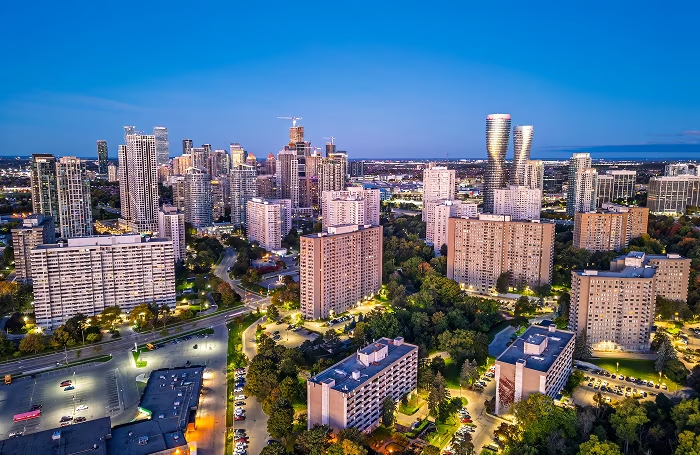
Hurontario: Mississauga's densest transit corridor, a high-volume new-build condo market, and the neighbourhood most directly tied to an LRT that keeps missing its opening date. Hurontario refers both to the major north-south arterial street and the residential and commercial fabric that flanks it through the centre of Mississauga. This is not a compact neighbourhood with a single character. It is a corridor district spanning roughly from Queensway in the south to Highway 407 in the north, with the City Centre and Square One at its core. This page is written for buyers and sellers who want to understand what that means for their decision, not a marketing summary of Mississauga's "urban potential."
Market positioning
Hurontario sits at the intersection of two competing forces: strong transit-oriented development pressure pushing density and new supply, and a softened condo market where investor-heavy product is sitting longer and selling below ask. The active pricing range today is detached at $1.4M to $1.65M, semis at $900K to $1.05M, and condos at $520K to $750K with high volume of new builds in the lower tier. The most important pricing reality is the spread within condos: older resale units in dated 1980s to 1990s buildings trade at a discount to new pre-construction, and new completions are flooding supply in the City Centre orbit. Buyers who conflate "near Square One" with "good condo investment" without distinguishing building age, maintenance fees, and reserve fund status are taking on avoidable risk. The detached and semi-detached product in Cooksville and the established residential pockets east and west of Hurontario Street represents a different, calmer sub-market with genuine family demand.
Housing stock and property-type fit
The corridor has two fundamentally different housing layers. The first is the high-rise condo belt concentrated along Hurontario Street itself and around Square One and City Centre, towers from the 1980s through current pre-construction, with a heavy new-build pipeline. The second is the established residential fabric east and west of the corridor: 1960s to 1980s detached and semi-detached brick homes on 35 to 50 ft lots in pockets like Cooksville (Clayhill, Paisley), Mississauga Valleys, and the Gordon Woods enclave behind Trillium Hospital. Gordon Woods specifically is an anomaly. Custom homes on larger lots with significant character, originally developed in the 1930s to 1950s and substantially rebuilt in the 1980s to 1990s, priced materially above the Cooksville average. Buyers must decide which layer they are actually targeting before shortlisting, because the commute logic, lifestyle, and capital-expenditure profile are entirely different between a 1970s detached on a quiet street and a pre-construction condo tower on Hurontario.
Real estate performance and buyer behaviour
Investor relevance is high in the condo segment and the thesis is the Hazel McCallion LRT, but that thesis has been repeatedly delayed and buyers must understand the current risk profile. The LRT, originally contracted for a fall 2024 opening, remains without a confirmed opening date as of early 2026. As of December 2025, Mississauga's mayor stated she does not expect the line to open before 2029, putting it roughly four to five years behind the original schedule. Nine of nineteen station platforms were complete as of late 2025. The condo market along the corridor is consequently over-supplied relative to the transit demand that was priced in during the 2020 to 2022 pre-construction boom: days on market are elevated, sale-to-list ratios are soft, and investors holding completed pre-construction units are facing negative carry. Detached and semi-detached product in Cooksville holds its demand better. Owner-occupier families are not as exposed to the LRT delay thesis.
Buyer fit
Best fit: Owner-occupier families targeting Cooksville detached or semi-detached with Cooksville GO walkability, urban professionals buying a primary residence near Square One with a car-free commute to downtown Mississauga, end-user condo buyers who will live in the unit and are not underwriting an LRT-uplift investment thesis, buyers working in the Mississauga corporate corridor (Square One office cluster, Hwy 403 tech parks).Probably avoid: Investors who bought pre-construction in 2021 to 2022 at peak pricing expecting LRT-driven appreciation by 2025. That window has not closed but has been pushed materially. Also avoid buyers who expect Toronto-style walkable neighbourhood character; the Hurontario corridor is commercially dense but not pedestrian-friendly in the way midtown Toronto is. Walk Score of 46 reflects the reality accurately.
Schools strategy
The Hurontario district is served by the Peel District School Board (PDSB) and Dufferin-Peel Catholic District School Board (DPCDSB). Notable public secondary schools include Rick Hansen Secondary School and T.L. Kennedy Secondary School for the Cooksville catchment. French immersion access runs through Bristol Road Middle School (Grades 6 to 8) and Camilla Road Senior PS, with secondary FI at Applewood Heights Secondary School. Catholic options include St. Francis Xavier Secondary School. School quality in the Hurontario corridor is generally solid but not a primary purchase driver the way it is in Forest Hill or Lawrence Park. Buyers here are more commonly making transit and value decisions than school-tier decisions. Address-level catchment verification applies as always.
Cultural communities and places of worship
Hurontario and the surrounding Mississauga City Centre corridor is one of the most ethnically diverse urban zones in Canada outside Toronto proper. South Asian communities, primarily Indian and Pakistani, represent a significant share of the condo and townhome demographic, particularly in the newer builds. Chinese, Filipino, and Middle Eastern communities are well-represented across the corridor. The Cooksville pocket has historic West Indian and Caribbean presence, reflected in independent food shops along Dundas. Worship infrastructure is dense: Hindu temples, mosques, Sikh gurdwaras, evangelical and Catholic churches are distributed throughout the corridor. The practical implication for buyers is that cultural amenity access is genuinely strong here. The diversity is not a demographic abstraction but shows up in grocery, restaurant, worship, and community service infrastructure at street level.
Grocery, lifestyle, and daily-use anchors
Square One Shopping Centre is the anchor for the entire district, Ontario's largest mall, with a full grocery, restaurant, cinema, and retail cluster. It is a regional destination rather than a local village, which means it handles bulk shopping well but does not replicate walkable neighbourhood retail. Cooksville and the Dundas corridor have Caribbean and South Asian independent grocery and food shops. Heartland Town Centre to the north provides additional big-box retail. Kariya Park near City Centre is a well-regarded Japanese-inspired garden used as an outdoor amenity by condo residents. The honest assessment is that daily retail convenience is car-dependent outside the Square One orbit, and the corridor's Walk Score accurately reflects that the built environment favours driving rather than walking for most errands.
Transit, highways, and mobility
This is the defining section for this neighbourhood. Current transit consists of Cooksville GO Station on the Milton Line (direct to Union Station, roughly 30 to 40 minutes), the Mississauga Transitway BRT running east-west through City Centre, and MiWay buses on Hurontario serving the full north-south corridor. The express bus from Square One GO Bus Terminal to downtown Toronto runs approximately 50 to 60 minutes. Highway access is exceptional: Hwy 403 is 1 to 3 minutes from the corridor centre, Hwy 401 is 5 to 8 minutes north, Hwy 407 is 10 minutes, and QEW is 12 to 15 minutes south. The Hazel McCallion LRT is under active construction on 18 km of dedicated right-of-way from Port Credit GO to Brampton Gateway Terminal, with 19 stops including connections to Cooksville GO and the City Centre loop. Originally contracted for a fall 2024 opening, the project has no confirmed opening date as of March 2026. Mississauga's mayor publicly stated in December 2025 that she does not expect the line open before 2029. Buyers underwriting an LRT transit premium should factor that delay into any hold-period modelling.
Parks, trails, recreation, and outdoor use
Green space in the Hurontario corridor is present but not exceptional relative to the district's density. Kariya Park near City Centre is the most distinctive local amenity, a Japanese-style garden that functions as a genuine neighbourhood park for condo residents. Mississauga Valley Park provides multi-use sports and recreation facilities in the Cooksville pocket. Huron Heights Park and several smaller parks serve the residential streets east and west of the corridor. Credit River ravine and trail system is accessible within a short drive south toward Port Credit. The outdoor offer here is functional rather than distinctive. It does not compare to Scarborough's Bluffs or the Don Valley system in Toronto. Buyers who weight outdoor access heavily should compare Hurontario against Port Credit or Erin Mills before committing.
Environmental and infrastructure risk analysis
The primary environmental risk specific to Hurontario is construction disruption, not a permanent condition, but material for the near term. Hurontario Street itself has been under LRT construction since 2020 and continues to affect traffic patterns, business access, and street-level livability along the corridor. That disruption is a known temporary cost that will resolve when the LRT opens, but the timeline remains uncertain. The residential pockets east and west of the corridor (Cooksville detached stock) carry standard postwar inspection risk: 1960s to 1970s construction with clay drains, older electrical panels in some homes, and foundation moisture in properties with basement finishing work. Condo buyers in older high-rise towers on Hurontario should scrutinise the status certificate for reserve fund adequacy and any outstanding special assessment risk. 1980s to 1990s concrete towers in this corridor have accumulated deferred maintenance that is increasingly becoming a financial event for unit owners.
Better alternatives, substitution, and affordability strategy
Buyers targeting the condo-plus-transit thesis who are uncomfortable with the LRT delay risk should compare directly against Cooksville GO Station-adjacent product where the GO Milton Line is running today, not pending. Buyers who want more established family neighbourhood character at a similar or lower price point should compare Mississauga Valleys, Fairview, and the Camilla Road corridor. All offer 1970s to 1980s detached product with Square One proximity at a lower price than the Gordon Woods or City Centre premium zones. Port Credit is the direct premium substitute for buyers who want waterfront walkability at higher cost. Erin Mills offers more space per dollar with Credit Valley Hospital proximity and UTM access for buyers who prioritise those anchors over the Hurontario transit corridor.
Forward outlook and holding power
The Hurontario corridor's long-term outlook is structurally positive for one reason: Mississauga's City Centre is one of the few locations in the GTA outside Toronto proper that has genuine high-density transit-oriented development at scale, with the Square One supernode and the LRT corridor together representing a planned urban intensification programme that has provincial and municipal commitment behind it. When the Hazel McCallion LRT opens, whether in 2028, 2029, or later, it will fundamentally change the commute calculus for the corridor and validate the development density that has been built in anticipation of it. The risk is the holding cost until that happens: investors carrying negative-carry pre-construction completions in a soft condo market with no confirmed LRT opening date are in a difficult position right now. End-user buyers and long-hold investors with a five-plus year horizon have a rational case. Anyone expecting near-term appreciation driven by an imminent transit opening should revisit that assumption against the current construction timeline.

Schools
Parks
Hospitals
Transit
%20(1).avif)
.svg)

.svg)
A Local Agent You Can Trust
I do more than just buy and sell properties — I guide families through complex transitions with care, patience, and full hands-on support. From staging and preparations to move-in day, I’m here to handle every detail so you can focus on what matters most.