.svg)
A Curated Guide to Toronto’s Premier Neighbourhood


Book a strategy session

.svg)

.svg)
.svg)
Summerhill, Toronto: A Buyer Intelligence Brief
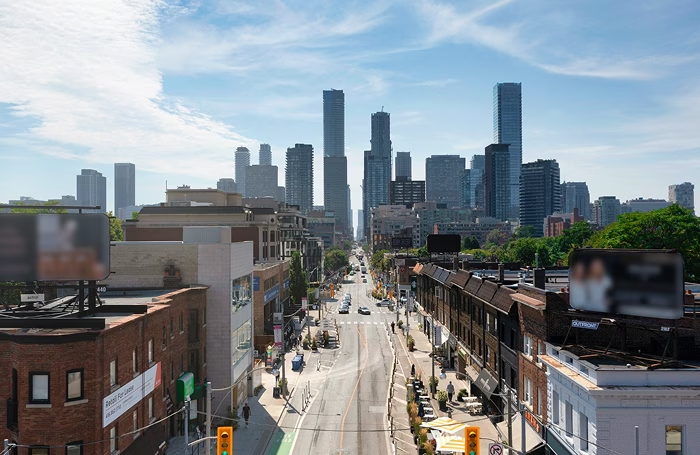
Summerhill: the sweet spot between Rosedale's exclusivity and Yorkville's density, with Summerhill Station at its core, Victorian and Edwardian housing stock from 1880 to 1915, and a Yonge Street commercial strip that functions as one of the best walkable urban village corridors in Toronto. The neighbourhood sits between Farnham Avenue to the north, Pears Avenue to the south, with Yonge Street as its western spine and tree-lined streets extending east toward Rosedale. It is small in population (roughly 5,400 residents), high in ownership (over 90%), and low in turnover, which is precisely what makes it one of Toronto's most durable real estate markets. This page is written for buyers and sellers who want the real decision-making layer, not a guided tour of the LCBO.
Market positioning
Summerhill should be understood as Rosedale's more accessible sibling: sharing the same ravine access, the same subway line, the same tree-canopied streets and Victorian character, but without the Rosedale address premium and with the additional advantage of a functioning commercial village on its doorstep. The active pricing range today is houses at $2.5M to $5.5M+ and luxury condos and townhomes at $1.2M to $2.8M. The internal pricing spread reflects lot size and street position more than housing type: premium streets like Woodlawn Avenue and Woodlawn West with 40 to 60 ft lots command the top of the range, while the narrow Victorian semis and rows on 20 to 25 ft lots in the core represent the entry point into the neighbourhood. The critical market reality is that Summerhill offers roughly the same quality of life as Rosedale at a consistent 15 to 25% discount on equivalent product, a differential that has attracted buyers who understand both markets for decades.
Housing stock and property-type fit
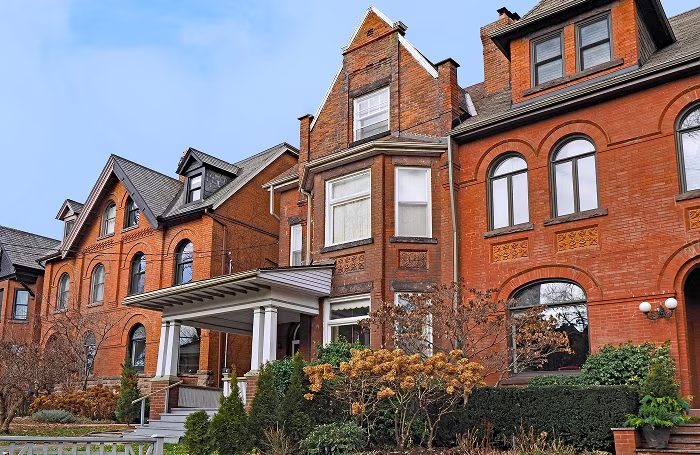
The original stock, built from 1880 to 1915, is predominantly Victorian and Edwardian semi-detached and detached brick homes with characteristic tall narrow facades, bay windows, and front porches. Most do not have driveways, which is both the defining constraint and the defining character of the neighbourhood: street parking permits are available from the city, and most residents accept the trade-off as the price of living in architecturally intact streetscapes that cannot be replicated in the GTA. The post-1980s additions include low-rise condo buildings and modern townhomes concentrated along the Yonge corridor, providing lower-maintenance product at the $1.2M to $2.8M tier for buyers who want the address without the heritage capital commitment. The heritage stock itself is fully within a renovation cycle: original-condition semis come to market as value plays for buyers who want to customise, and recently completed full renovations command premium pricing. The absence of driveways and the narrow lot profile mean that the buy-and-build teardown dynamic seen in Bedford Park-Nortown does not apply here. The value of the stock is in the architecture, not the land.
Real estate performance and buyer behaviour
Summerhill is one of Toronto's most illiquid prestige markets in the best sense: turnover is low, over 90% of residents own, and when properties come to market they attract qualified buyers quickly. The neighbourhood has historically outperformed Toronto's broader prestige tier in price retention during downturns because the buyer pool is end-user concentrated rather than investor-heavy. Investor relevance is medium-high in the condo and townhome tier, driven by the premium rental market for corporate tenants and professionals who want the address without the capital commitment of freehold purchase. The strongest-performing listings are fully renovated Victorian semis and detached homes on the better residential streets, priced in the $3M to $4.5M range, which attract the widest qualified buyer pool and typically move in under 30 days.
Buyer fit
Best fit: Established professionals and executives who work downtown and want a 10-minute subway commute from a genuine residential neighbourhood, empty-nesters downsizing from larger North Toronto homes who want walkability without condo tower density, families with children who want character housing, strong school access, and proximity to the Yonge corridor, buyers who want the Rosedale lifestyle at a discount and understand the no-driveway trade-off.Probably avoid: Buyers who require a car as a primary mode of daily transportation and are not willing to street park, buyers who want large lots and backyard depth comparable to Lawrence Park or Forest Hill (Summerhill's lots are generally narrow and short), buyers expecting contemporary open-concept layouts without significant renovation capital, buyers conflating Summerhill's Yonge Street commercial vibrancy with proximity to downtown-core nightlife or entertainment density.
The defining buyer trade-off is parking versus character: virtually every competitor neighbourhood at this price point offers driveways. Summerhill does not. Buyers who internalise that trade-off as acceptable are buying one of the most architecturally intact Victorian urban environments in Toronto. Buyers who cannot accept it should look at Leaside or Moore Park.
Schools strategy
Summerhill's school layer is excellent without being dominated by a single flagship institution in the way Forest Hill or Bedford Park-Nortown are. Public school catchment runs to Cottingham Junior Public School, a well-regarded TDSB elementary, and Deer Park Junior and Senior Public School. Secondary catchment falls to North Toronto Collegiate Institute, one of Toronto's strongest public secondary schools with a consistent academic reputation. Private school access is exceptional given the neighbourhood's central location: The York School (private, JK to 12) is directly on Yonge Street within the neighbourhood. De La Salle College (Oaklands) is on Farnham Avenue at the northern boundary. Branksome Hall is a short distance east. The nearby Rosedale and Yorkville proximity also provides access to UCC, BSS, and Crescent School within a reasonable travel radius. French immersion access runs through Davisville Junior PS and Brown Junior PS (Early Immersion), with Deer Park offering secondary pathways. The school environment here is not as school-premium-driven as Bedford Park-Nortown or Forest Hill; buyers come for the location and lifestyle, and strong school access is a component rather than the primary purchase driver.
Cultural communities and places of worship
Summerhill is an established Anglo-Canadian and upper-professional neighbourhood with very low cultural diversity relative to the broader Toronto market, reflecting its price tier and historically consistent ownership demographics. The community is small by Toronto standards (roughly 5,400 residents) with a high proportion of finance, legal, media, and professional-sector households. There is no dominant visible minority community presence and no significant ethnic commercial infrastructure on the main corridor. The Yonge Street commercial strip reflects the demographic: it is upscale, independent, and curated toward a specific lifestyle that skews affluent and urban-professional rather than multicultural. Relevant worship includes St. Paul's Anglican Church and St. Andrew's United Church serving the historic Protestant congregation demographic in the area. Catholic parishes are accessible nearby in the Rosedale corridor.
Grocery, lifestyle, and daily-use anchors
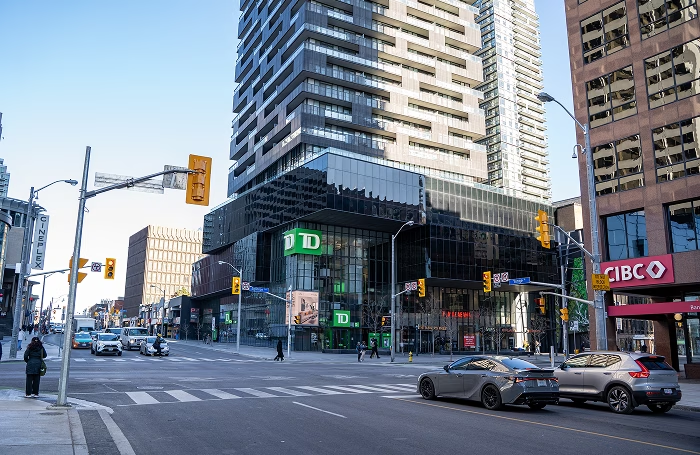
The Yonge and Summerhill Avenue corridor is one of Toronto's best neighbourhood commercial strips at this scale. Summerhill Market at 446 Summerhill Avenue is the neighbourhood's beloved independent grocer, butcher, and prepared-foods destination, functioning as both a practical daily anchor and a social institution. Pusateri's is accessible nearby. The Harvest Wagon, Oliffe Butcher, Pisces Seafood, and Nadège Patisserie provide specialty food access within walking distance. The LCBO in the 1916 North Toronto Railway Station clocktower building is a destination store for wine and spirits, architecturally distinctive and stocked with an inventory breadth that matches the neighbourhood's affluence. Restaurant density on Yonge near Summerhill includes Terroni Price Street (Italian, destination dining), Boxcar Social (café and cocktails), Sorrel, the Rosedale Diner, and a range of café and brunch options. The Toronto Lawn Tennis Club and York Racquets Club are within the neighbourhood, providing private club access for the racquet-sports demographic. The Cottingham Tennis Club offers clay courts and a historic CPR building setting. For broader retail, Bloor-Yorkville is walkable to the south. Yonge and St. Clair is accessible to the north.
Transit, highways, and mobility
Summerhill Station on Line 1 Yonge-University is the anchor transit node, with a downtown commute of approximately 10 to 11 minutes to King or Queen stations. Walk Score of 97 reflects the reality: daily needs including grocery, pharmacy, café, restaurant, and specialty retail are all accessible on foot without a car. Bike Score of 87 reflects the ravine trail connections and relatively calm residential streets. Highway access is present but not the primary mobility logic: the DVP is 8 to 12 minutes via Rosedale Valley Road, and the 401 is 15 to 20 minutes north. There is no GO Transit node; regional travel requires driving to a GO station or taking the subway to Union. For buyers whose professional life is downtown Toronto, Summerhill's transit position is one of the most convenient in the city. The absence of driveways is less of a liability in a neighbourhood where most daily needs are walkable and subway access is immediate.
Parks, trails, recreation, and outdoor use
David A. Balfour Park is the primary green anchor, spanning over 50 acres along Yellow Creek east of Yonge Street, with running, walking, and biking trails that connect into the Vale of Avoca ravine system and south to the Kay Gardner Beltline Trail. Rosehill Reservoir Park to the north provides footpaths, reflecting pools, a children's playground, and connections to ravine trails with waterfall features. Both parks are walkable from virtually every residential street in the neighbourhood. The ravine trail network places Summerhill residents within minutes of one of Toronto's most extensive off-street green corridors, a meaningful quality-of-life differentiator for a dense urban neighbourhood. The Toronto Lawn Tennis Club and York Racquets Club provide private outdoor recreational infrastructure. The Beltline Trail connects west and east for cyclists and runners. For buyers who value urban outdoor access, Summerhill's ravine and park network is comparable to Rosedale and materially better than most Midtown Toronto alternatives at this price tier.
Environmental and infrastructure risk analysis
Environmental risk in Summerhill is low and specific. The ravine and Yellow Creek corridor through David A. Balfour Park carries standard TRCA designation; properties backing onto the ravine edge should confirm setback and drainage status before offering, but the residential streets are not in floodplain risk zones. The heritage housing stock from 1880 to 1915 carries the full spectrum of older-home capital risk: knob-and-tube wiring in homes not yet rewired, original clay or lead drain lines, slate roofs requiring specialist maintenance, no insulation in original envelope construction, foundation moisture in homes with finished basement additions, and inadequate electrical service capacity for modern household loads. Buyers purchasing original-condition Victorian stock should commission a pre-offer structural assessment and budget 10 to 20% of purchase price for immediate capital work, as surprises post-closing on a $2.5M to $3.5M acquisition can be significant. The absence of driveways means no private off-street parking, which is a structural feature of the neighbourhood rather than an individual property deficiency. The Yonge Street corridor immediately adjacent to residential streets carries moderate ambient noise from commercial traffic, a factor worth verifying on-site for the streets closest to the main commercial node.
Better alternatives, substitution, and affordability strategy
For buyers who want the same subway access and Victorian character but cannot reach the $2.5M+ freehold entry point, the most practical alternative is the lower end of the Yonge-St. Clair condo and townhome tier, which provides an address adjacent to Summerhill at lower capital. For buyers who want more lot depth and driveway access at a comparable prestige tier, Moore Park to the east offers larger lots with Summerhill-comparable proximity to Rosedale Valley trails at broadly similar pricing. Leaside offers newer postwar detached stock with driveways and strong schools at $1.8M to $3M, for buyers who prioritise driveway and yard depth over Victorian character. Rosedale is the premium substitute for buyers who want to move up within the same character tier at a higher price, accepting that Rosedale's Bloor-Sherbourne subway access is weaker than Summerhill's.
Forward outlook and holding power
Summerhill is one of Toronto's most structurally durable markets. The hold thesis does not depend on transit upgrades, school catchment changes, or speculative development. It rests on three immovable facts: Summerhill Station subway access will not change, the Victorian heritage streetscape cannot be replicated or substantially densified, and the neighbourhood's position between Yorkville and Rosedale places it permanently in Toronto's top-tier midtown corridor. Turnover is low by design and by culture. The buyer pool is global at the high end and deep domestically at the entry level, because professionals relocating to Toronto from London, New York, or Hong Kong identify Summerhill immediately as the type of neighbourhood they already understand. Price corrections in this market are typically shallower than the broader Toronto market and recovery is faster. For long-hold buyers, Summerhill is as close to a bond as residential real estate gets in this city.

Schools
Parks
Hospitals
Transit
%20(1).avif)
.svg)

.svg)
A Local Agent You Can Trust
I do more than just buy and sell properties — I guide families through complex transitions with care, patience, and full hands-on support. From staging and preparations to move-in day, I’m here to handle every detail so you can focus on what matters most.