.svg)
Where Tradition Meets Modern Family Living


Book a strategy session

.svg)

.svg)
.svg)
Bedford Park-Nortown, Toronto: A Buyer Intelligence Brief
Bedford Park-Nortown: North Toronto's most accessible entry point into the Lawrence Park prestige tier, with subway-adjacent detached housing, a concentrated private school cluster, and a buy-and-build market that continues to attract high-income family buyers. The neighbourhood sits north of Lawrence Avenue, bounded by Bathurst Street to the west, Highway 401 to the north, and zigzagging between Avenue Road and Yonge Street. It is not as expensive as Lawrence Park proper, not as prestigious as Rosedale, but it delivers more of the same inputs (schools, ravine access, subway, mature trees, detached housing) at a lower absolute entry price. This page is written for buyers and sellers who want the real decision-making layer, not a summary of tree-lined streets.
Market positioning
Bedford Park-Nortown should be understood as the functional equivalent of Lawrence Park at a modest discount, sharing the same school catchments, similar housing character, and direct subway access, but without the brand premium of Lawrence Park's address. The active pricing range is detached at $2.2M to $4.8M+, luxury semis at $1.6M to $2.1M, and condos at $850K to $1.5M. The more important pricing story is the internal spread between original-condition homes from the 1890s to 1940s, which sell as land with a teardown premium attached, and recently built or extensively renovated product on the same streets, which commands $4M to $5M+ for custom finishes on 40 to 50 ft lots. The average sold price sits around $2.3M but that number obscures the bimodal distribution: buyers are either buying original stock to renovate or tear down, or paying significantly above that average for already-done product. The buy-and-build and buy-and-renovate segments are the dominant activity in this market.
Housing stock and property-type fit
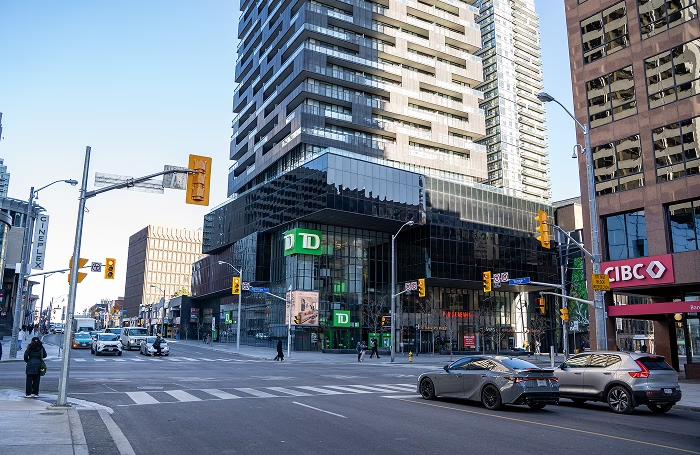
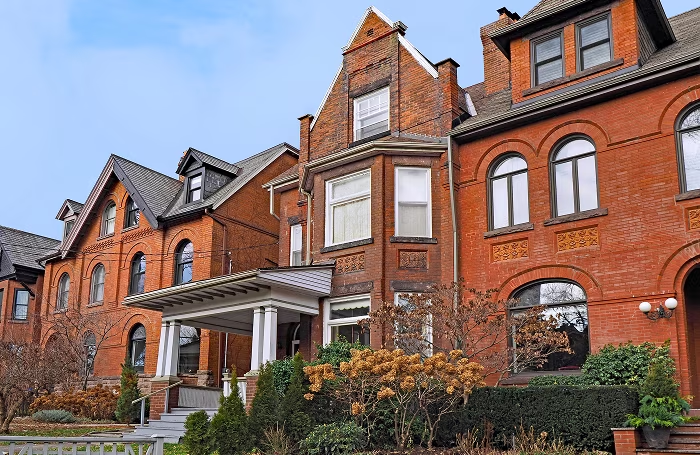
Original housing stock dates to 1890 to 1940, detached and semi-detached homes on 40 to 50 ft lots, primarily in Tudor, Georgian, and Arts and Crafts styles that characterise North Toronto of that era. A significant portion of that stock has been replaced or substantially rebuilt: the 25 to 30 ft modern infill on narrow lots is increasingly present, the result of lot severances on larger parcels. Premium lots of 60 ft+ exist on select streets and carry material price premiums. The condo layer is limited relative to the neighbourhood's scale, a small number of low-rise and mid-rise buildings along the Yonge and Avenue Road commercial corridors. For buyers coming from a condo background, the transition to a 1920s detached with original systems is a capital-planning exercise, not just a lifestyle upgrade. Buyers should budget for post-purchase capital work unless buying a recently completed custom build or full renovation.
Real estate performance and buyer behaviour
Bedford Park-Nortown moves faster than its price tier suggests it should. Current data shows 25% of homes selling in under 10 days and 25% selling above asking, competitive metrics for a $2M+ market. Sale-to-list ratio sits near 99%, indicating the market is pricing accurately rather than being pushed by speculative overbidding. Investor relevance is medium-high: the buy-and-build segment is active and financially rational given land values, and luxury rental demand for fully renovated detached homes is real from corporate tenants and relocating executives. The strongest-performing listings are custom-built or comprehensively renovated homes priced in the $3M to $4.5M range on standard lots. These attract the widest pool of qualified buyers and move without extended market exposure. Original-condition homes price to the land and attract a different, more sophisticated buyer calculating tear-down-and-rebuild math.
Buyer fit
Best fit: High-income families with children prioritising Lawrence Park CI or Havergal College proximity, buyers moving north from Rosedale or Forest Hill who want Lawrence Avenue-adjacent living at a slightly lower price point, buy-and-build buyers targeting older stock on premium lots, corporate households requiring a subway commute combined with large-lot family living.Probably avoid: Buyers expecting Forest Hill-style critical mass of high-end retail and restaurant density within walking distance. The Avenue Road commercial strip is pleasant but not deep. Also avoid buyers who need condo liquidity and low maintenance, and buyers who cannot absorb significant renovation or rebuild capital on top of the acquisition price for original-condition stock.
The key distinction from Lawrence Park is social rather than geographic: Lawrence Park buyers are frequently buying the address itself as a status signal. Bedford Park-Nortown buyers are typically buying the same physical product, schools, and commute, while applying that capital difference to the house itself. Neither choice is wrong; they reflect different priorities.
Schools strategy
School infrastructure is the primary demand driver for this neighbourhood's price premium and it is among the best-stocked school environments in Toronto. Public secondary catchment falls to Lawrence Park Collegiate Institute, which serves Bedford Park, Lytton Park, and North Toronto catchments and carries a strong academic reputation. French immersion runs through John Wanless Junior Public School and Bedford Park Public School at the elementary level, with secondary FI at Lawrence Park CI. The private school concentration is exceptional: Havergal College, one of Canada's top independent girls' schools (JK to 12), occupies a 22-acre campus on the corner of Avenue Road and Lawrence, directly in the neighbourhood. The surrounding area also supports access to Upper Canada College and other North Toronto private schools within a short drive. The neighbourhood offers 10 private schools, 12 public schools, and 7 Catholic schools in or immediately adjacent to it, with special programmes spanning French immersion, Jewish day school, Montessori, gifted, AP, and IB. For households with specific school requirements, this is one of the densest single-neighbourhood school option sets in the GTA.
Cultural communities and places of worship
Bedford Park-Nortown is a predominantly established Anglo-Canadian and Jewish professional demographic, reflecting the historic North Toronto character of the Lawrence-Avenue Road corridor. The Jewish community has a significant institutional presence: multiple synagogues, Jewish day schools, and community organisations operate within or immediately adjacent to the neighbourhood. The broader demographic skews to highly educated professionals in their 40s and 50s with children, consistent with a neighbourhood defined by school access and housing quality rather than cultural arrival or transition. A Chinese community presence of roughly 10% exists, consistent with professional household migration into the area rather than a distinct commercial cultural cluster. Crime rates are documented at approximately 72% below the national average, which reinforces the neighbourhood's settled, stable character. Relevant worship includes multiple synagogues along Bathurst and Lawrence, Catholic parishes on the western edge, and Anglican and United churches mid-neighbourhood.
Grocery, lifestyle, and daily-use anchors
The daily retail layer is centred on two corridors: Avenue Road between Lawrence and Wilson for boutique dining and specialty retail, and Yonge Street for standard urban commercial. Pusateri's Fine Foods at Avenue Road is the primary premium grocery anchor, a genuine neighbourhood institution for the local demographic. Lawrence Farmers Market provides seasonal local produce access. Metro on Yonge handles standard grocery runs. The Avenue Road strip has accumulated a solid restaurant and cafe cluster including Auberge du Pommier for high-end dining, Café Landwer for daily-use Israeli-Mediterranean, Pizzeria Via Mercanti, and North of Brooklyn. This is not Yorkville-density retail, but it is a functional, pleasant walkable corridor for the neighbourhood's core needs. Yorkdale Shopping Centre is a short drive or bus ride north for any major retail need. The honest assessment is that the retail layer supports comfortable daily living for the demographic that lives here, without the depth or novelty of Annex or Leslieville.
Transit, highways, and mobility
Lawrence Station on Line 1 Yonge-University is the anchor transit node, providing direct subway access to downtown in 16 to 20 minutes. York Mills Station is accessible from the northern edge. Bus service runs on Avenue Road (Route 61) and Yonge Street (Route 97), connecting the western portions of the neighbourhood without requiring a car for basic transit. Highway 401 is 5 to 8 minutes north via Avenue Road or Yonge, and Allen Road provides 8 to 12 minute access to the 400 westbound. There is no direct GO Transit node. GO access requires driving to Old Cummer or Oriole stations, adding complexity for buyers who commute regionally. For downtown-office commuters, the Lawrence Station subway access is the primary mobility logic and is genuinely strong. For hybrid workers with occasional regional travel requirements, the 401 proximity covers the car-based need adequately. This is a neighbourhood that functions well for subway-dependent commuters and car-optional families alike, which broadens the buyer pool relative to transit-dependent-only markets.
Parks, trails, recreation, and outdoor use
Wanless Park is the neighbourhood's primary green anchor, offering basketball courts, baseball diamonds, five flood-lit tennis courts, a wading pool, and a children's playground, the core recreational infrastructure for the area's family demographic. Ledbury Park adds a community centre with an indoor pool, skating rink, and outdoor swimming pool. Lawrence Park ravine and the Beltline Trail provide linear green access connecting into the broader Toronto ravine system. Havergal College's 22-acre campus contributes a buffer of mature trees and open space along the Avenue Road corridor. The Don Valley Golf Course is accessible from the eastern edge via the ravine trail system. Edwards Gardens and the Toronto Botanical Garden are a short drive east. The outdoor offer is appropriate for a dense family neighbourhood: well-maintained, multi-use, and embedded in the street fabric rather than a single large park at a distance.
Environmental and infrastructure risk analysis
Environmental risk is low relative to most Toronto neighbourhoods. The neighbourhood sits on stable ground away from major floodplains. The ravine system is present at the edges but does not create meaningful flood risk for the residential core. The primary capital risk is structural: housing stock from the 1890s to 1940s carries the full roster of older-home inspection concerns, including knob-and-tube wiring in homes not yet rewired, original clay drain lines, asbestos insulation in pre-1980 renovations, foundation moisture in homes with added below-grade living space, and flat or shed-roof additions with deferred maintenance. Buyers purchasing original-condition stock for renovation or tear-down should commission a full structural assessment before waiving conditions, since capital surprises post-closing on a $2.5M acquisition can be material. Modern infill and recently rebuilt homes on the same lots carry none of these risks and are priced accordingly. The proximity to the 401 along the northern boundary creates noise exposure for streets immediately adjacent, a factor that should be verified on-site for any address north of Wilson Avenue.
Better alternatives, substitution, and affordability strategy
The most direct substitute for buyers who want the same school and subway logic at a lower absolute price is Englemount-Lawrence immediately to the west, where post-war detached stock on the Bathurst corridor trades at a significant discount to the Avenue Road and Yonge premium. Buyers who want the Havergal and Lawrence Park CI school access but do not need the interior residential streets can consider Lytton Park, which shares the Lawrence catchment at similar or slightly lower pricing. For buyers stretching to get into the neighbourhood but finding $2.5M+ out of reach, Lawrence Avenue East condos along the subway spine offer a foothold address in the same commute zone at $850K to $1.5M, without the detached housing form. Buyers who want the North Toronto character without the price pressure at all should compare Bathurst Manor, which offers postwar detached at $1.4M to $2.2M with Allen Road and 401 access, at the cost of a weaker school tier and no subway walkability.
Forward outlook and holding power
Bedford Park-Nortown's value is structurally anchored by three independent drivers that do not require speculative assumptions: Lawrence Station subway access, the Havergal and Lawrence Park CI school cluster, and the irreplaceable land stock of detached homes on established lots within 20 minutes of the Financial District. These drivers do not change with interest rate cycles, which is why the neighbourhood has historically held value through downturns better than transit-adjacent or investor-heavy markets. The buy-and-build segment adds a floor: as long as construction costs and custom-build demand remain elevated, original-condition lots retain teardown value that prevents deep price corrections. The medium-term risk is infill densification pressure from the 401 corridor and the Avenue Road secondary commercial zone, where mid-rise development applications are a recurring municipal planning issue. Buyers on the northern and commercial edges should review OMB and Committee of Adjustment activity for adjacent parcels. For long-hold family buyers, this is one of the most defensible equity positions in North Toronto's mid-tier prestige market.

Schools
Parks
Hospitals
Transit

.svg)


%20(1).avif)

.svg)
A Local Agent You Can Trust
I do more than just buy and sell properties — I guide families through complex transitions with care, patience, and full hands-on support. From staging and preparations to move-in day, I’m here to handle every detail so you can focus on what matters most.