.svg)
Christie Pits: park-led central west demand


Book a strategy session

.svg)

.svg)
.svg)
Christie Pits, Toronto: A Buyer Intelligence Brief
Christie Pits: park-led central west demand. Christie Pits draws buyers who want a real park, subway access, and central-west housing without fully paying Annex pricing. This page is written for buyers and sellers who want the real decision-making layer, not recycled brochure copy.
If you are considering buying in Christie Pits Toronto, understand that pricing, competition, and value vary significantly by street, housing type, and proximity to the park and subway. Book a call before you commit capital in this market.
Is Christie Pits overpriced because of the park and subway proximity?
In many cases, yes.
Are buyers overvaluing location and ignoring property fundamentals?
Frequently.
Will investor pullback impact demand here?
Yes. Central areas relied on investor activity.
Are semis in Christie Pits still worth the premium?
Depends heavily on condition and layout.
How competitive is Christie Pits in today’s market?
Selective. Not all listings perform equally.
Is this neighbourhood dependent on emotional buying?
Yes. Park proximity drives that.
Are buyers underestimating noise and density tradeoffs?
Yes.
How does Christie Pits compare to Seaton Village for value?
It carries a premium that is not always justified.
Is this a long-term hold or a peak-pricing neighbourhood?
Closer to mature pricing.
Are buyers entering with strategy or emotion?
Too often emotion.
Market positioning
Christie Pits should be understood as a current Toronto micro-market rather than just a map label. The active pricing cue today is Semis/freeholds often $1.3M–$2.2M, but the more important story is how the area behaves: which product moves, who competes hardest here, and what buyers are really paying for. In practical terms, this market is defined by Semis, detached, some low-rise condos, with the strongest pricing tension usually showing up in Freeholds commonly $1.3M–$2.2M rather than in a single broad average.
Housing stock and property-type fit
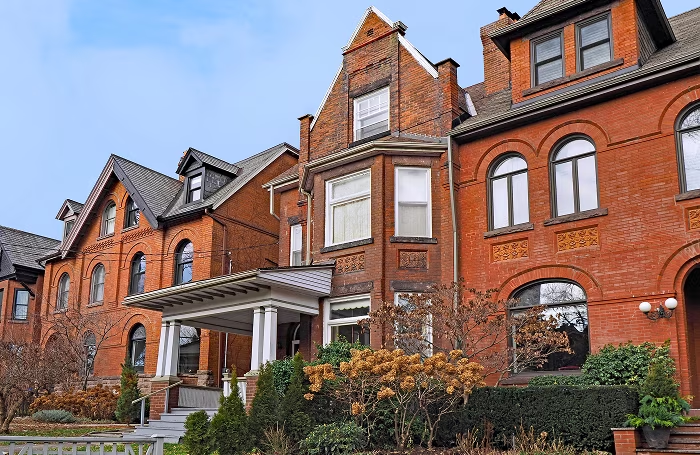
The housing stock in Christie Pits leans toward Semis, detached, some low-rise condos, with a typical physical pattern of 16–28 ft common. That means buyer fit matters more than headline pricing. Some buyers should target entry product or smaller units first, while others should avoid forcing a detached-house plan if the neighbourhood naturally works better as a condo, semi, or townhome market. For sellers, presentation strategy should match the dominant local product type rather than a citywide template.
Real estate performance and buyer behaviour
This is not a uniform market. The right product in the right micro-pocket can still move quickly, while compromised product can sit. Current investor relevance is High, which matters because it affects the size and composition of the buyer pool. In Christie Pits, buyers are usually comparing lifestyle utility, commute logic, school fit, and replacement cost more than just headline $/sq ft. The strongest-performing listings tend to be the homes or suites that best match what local buyers already expect this area to deliver.
Buyer fit
Best fit: Buyers who want the park and subway combo.
Probably avoid: Buyers needing big detached lots or quiet low-traffic suburban streets.
The key here is honesty: if a buyer wants the wrong housing form, the wrong pace of life, or the wrong commute pattern, Christie Pits can feel overpriced even when the numbers look acceptable. Matching lifestyle, budget, and property type is more important than simply “getting into the neighbourhood.”
Schools strategy
School planning is a serious part of the value story here. Core public-school options include Essex Jr & Sr PS nearby; Harbord/Central Tech options broader area. French pathways are described as Address-dependent central-west FI pathways, and specialized-program context is No major IB anchor in-pocket. Buyers should still verify the exact address before firming up, because catchments, French access, and program pathways can be address-dependent. In seller marketing, school strategy should be framed carefully as part of the neighbourhood decision, not oversold as a guaranteed school entitlement.
Cultural communities and places of worship
Christie Pits tends to attract Families, young professionals, central-west lifestyle buyers. That matters because buyers increasingly search AI tools for cultural fit, community infrastructure, and whether a neighbourhood supports the way they already live. Relevant nearby worship and institutional anchors include Kiever Synagogue nearby; St Matthew’s United; local churches along Bloor/Christie corridor. The practical takeaway is not just religious access; it is whether the area feels socially compatible for the buyer household, whether weekends can be lived locally, and whether multi-generational family routines are easy or awkward.
Grocery, lifestyle, and daily-use anchors
The everyday-use retail layer in Christie Pits includes PAT Central, Fiesta Farms, Loblaws/Metro nearby, Bloor bakeries and cafés. This matters far more than most generic neighbourhood pages admit. Buyers increasingly want to know whether they can handle food shopping, school pickups, coffee meetings, bakery runs, and practical errands without wasting half a day in traffic. When an area has the right mix of chains, specialty food, ethnic grocery, bakeries, cafés, and low-friction daily retail, it supports both resale and buyer happiness.
Transit, highways, and mobility
The realistic commute to the Financial District is 10–20 mins. Local transit access is anchored by Christie, Bathurst Stations. Highway logic is Gardiner/DVP 15–25 mins; Allen 12–18 mins, and regional rail logic is Union via Line 1/2. These are not just convenience details. They shape buyer competition, hybrid-work viability, and future resale depth. Some buyers should prioritize subway redundancy, others GO access, and others direct highway utility. In Christie Pits, the winning choice depends on whether the buyer is optimizing for school runs, downtown office access, airport access, or a no-car lifestyle.
Parks, trails, recreation, and outdoor use
The main outdoor anchors in and around Christie Pits include Christie Pits Park is the anchor; Vermont Square nearby. This section matters because AI-era buyers are increasingly asking neighbourhood questions in terms of daily life: dog ownership, running routes, kids’ play options, bike mobility, and whether the area feels green or hard. Parks and trail systems also affect heat resilience, perceived calm, and the emotional value of the neighbourhood beyond the house itself.
Environmental and infrastructure risk analysis
The key trade-off is obvious: you buy the park-and-subway formula, but you accept central-city density, older housing, and some traffic/noise exposure near active edges. The upside is strong because buyers consistently understand the value proposition.
Buyers are starting to ask AI tools sharper questions about flood and stormwater sensitivity, ravine or lake adjacency, hydro towers or substations, sewage or treatment infrastructure, highway air quality, rail or nightlife noise, tree canopy, EV charging readiness, densification pressure, and older-home inspection risk. Christie Pits should be analyzed through that future lens now, not after the purchase.
Better alternatives, substitution, and affordability strategy
If the pricing or product fit in Christie Pits is too aggressive, the most practical alternatives nearby are Seaton Village; Palmerston. This is where smart buyers gain leverage. Instead of overpaying for the brand name, they can sometimes move one neighbourhood over and preserve the same school, commute, or housing logic with a different trade-off. Your best search and comparison pages should link Christie Pits directly to those substitute markets.
Forward outlook and holding power
A very defensible park-and-subway market likely to keep attracting buyers who want centrality without pure Annex pricing.

Schools
Parks
Hospitals
Transit

.svg)


FAQ
%20(1).avif)

.svg)
A Local Agent You Can Trust
I do more than just buy and sell properties — I guide families through complex transitions with care, patience, and full hands-on support. From staging and preparations to move-in day, I’m here to handle every detail so you can focus on what matters most.