.svg)
Selling a Parent's Home in Ontario: The Probate Process Explained
Learn how to navigate the Ontario probate process when selling a parent's home, from obtaining the Certificate of Appointment to managing Estate Administration Tax and closing timelines.
.svg)

.svg)
.svg)
Selling a Parent's Home in Ontario: The Probate Process Explained
Selling real estate after the death of a parent in Ontario falls into a complex legal category. Under provincial law, only a court-appointed Estate Trustee has the legal authority to manage the deceased's assets and officially transfer title to a buyer.
This court approval process is known as Probate. Understanding how this procedure operates will help prevent financial losses, penalties from the Canada Revenue Agency (CRA) and protracted closing delays.
What Is Probate and Why Is It Required to Sell a House?
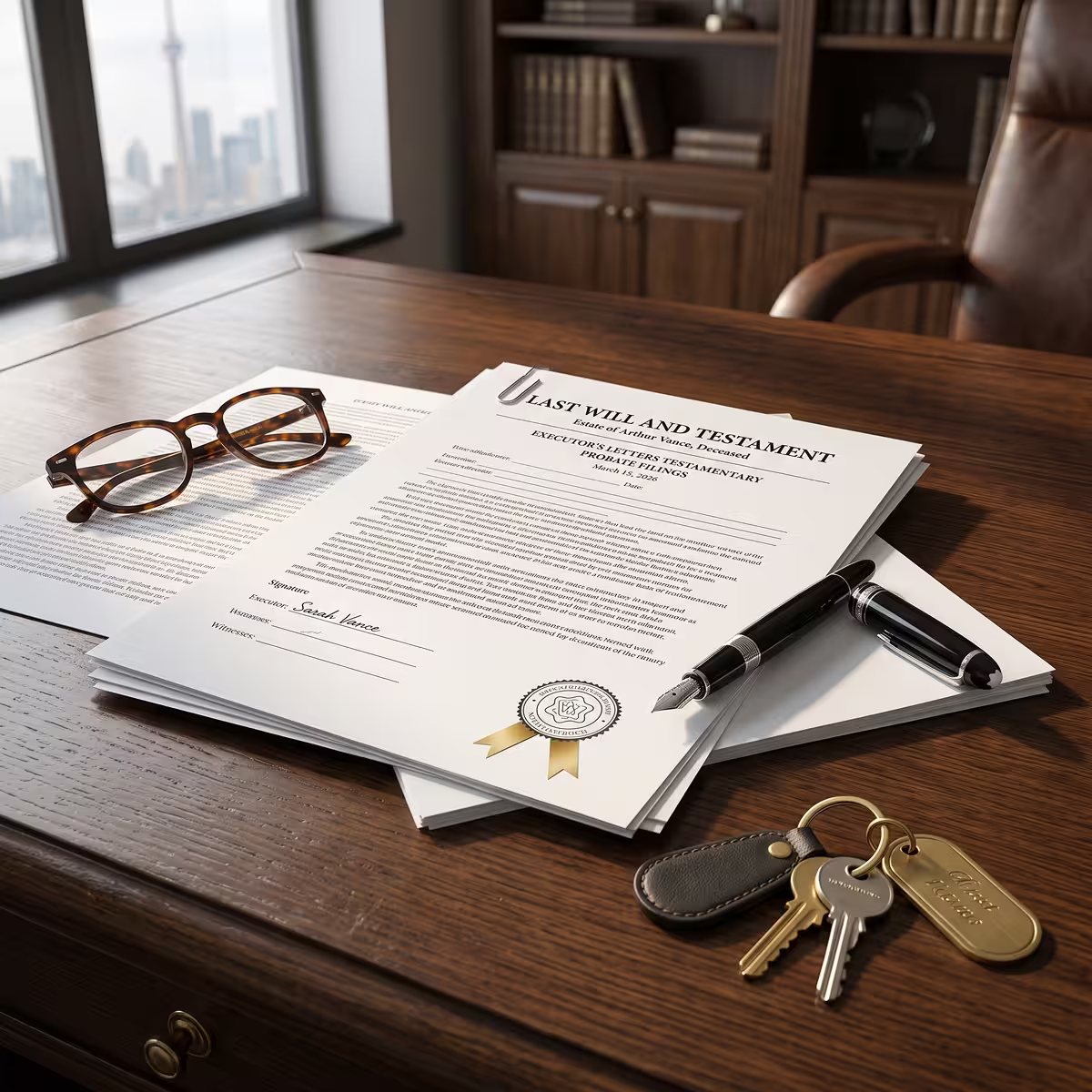
Probate is a formal court proceeding in the Superior Court of Justice of Ontario. Upon its completion, the court issues the executor an official document: a Certificate of Appointment of Estate Trustee.
This document serves two critical functions:
- Confirms the validity of the Will: The court certifies that the submitted Will represents the final, legally binding testament.
- Grants authority to the trustee: The Ontario Land Titles Registry and prospective buyers cannot transfer ownership without this certificate. Neither real estate agents nor lawyers can legally close a deal until the Estate Trustee receives judicial confirmation of their authority.
Exceptions apply when property is held in Joint Tenancy with right of survivorship, such as between spouses. In that scenario, ownership transfers automatically without probate. However, if both parents have passed away or the property belonged solely to one parent, probate becomes mandatory.
Estate Administration Tax (EAT)
When applying for probate, the Estate Trustee must pay Ontario's Estate Administration Tax (EAT). This tax is calculated based on the total fair market value of the estate's assets on the date of death.
Ontario EAT rates operate as follows:
- First $50,000 of estate value: $0 (exempt from tax).
- Every additional $1,000 (value exceeding $50,000): $15 (or 1.5%).
Sample calculation for a parent's home:
If a property is valued at $1,050,000 at the date of death, with no other estate assets:
- Remaining $1,000,000 = 1,000 * $15 = $15,000.
- Total EAT payable equals $15,000. This amount is due to the Ontario Ministry of Finance upon filing the court application.
When calculating EAT, any encumbrance or outstanding mortgage balance is deducted from the property's market value. No other debts of the deceased reduce the taxable estate value.
Capital Gains Tax on Inherited Property
At the date of death, a parent's principal residence is fully exempt from capital gains tax under the Principal Residence Exemption. However, the property's tax status changes following their death.
Upon death, the house transforms into an estate asset. If the property's market value appreciates while probate and sale proceed (for instance, valued at $1,000,000 at death and sold 8 months later for $1,080,000), the estate owes capital gains tax on the $80,000 gain.
Can You List a Property Before Probate Is Completed?
You can place a property on the market and sign an Agreement of Purchase and Sale before receiving the Certificate of Appointment. However, strict legal protocols must be followed:
- Specific Probate Clause: The Agreement of Purchase and Sale must include a condition making the closing date subject to the Estate Trustee obtaining the court certificate.
- Delay risks: Average probate processing times in Ontario courts range from 6 to 12 weeks, while major jurisdictions like Toronto can take 4 to 5 months. Should the closing date pass before the court grants the certificate, the buyer may have the right to terminate the agreement.
- Occupancy Agreement: If a buyer needs to move in prior to probate completion, real estate lawyers can draft an occupancy agreement allowing the buyer to reside in the home as a tenant until formal transfer of title.
Step-by-Step Guide to Selling a Parent's Property
- Date-of-death valuation: Establish the property's fair market value on the date of death using a licensed appraiser or experienced real estate professional. This value determines the EAT liability and sets the tax baseline.
- Court application filing: The Estate Trustee, alongside an estate lawyer, submits Form 74.4 to the Superior Court of Justice and pays the estimated EAT.
- Property listing: Prepare the home for sale and list it on the MLS, incorporating appropriate probate clauses within any offers.
- Obtaining the Certificate of Appointment: Once the court reviews and approves the application, the Estate Trustee receives full legal authority to transfer title.
- Closing and distribution: The real estate lawyer transfers title to the buyer, clears estate liabilities, and the remaining funds are distributed to beneficiaries according to the Will.
Handling an inherited property sale requires strict legal accuracy, strategic planning and disciplined timeline management. If you plan to sell a parent's home in Ontario and want to navigate probate without delays, financial loss or unnecessary risks, contact me today for a consultation. I will thoroughly review your situation, build a secure strategy and guide your deal smoothly to a successful closing.

Related Insights

.svg)


.svg)
A Local Agent You Can Trust
I do more than just buy and sell properties — I guide families through complex transitions with care, patience, and full hands-on support. From staging and preparations to move-in day, I’m here to handle every detail so you can focus on what matters most.