.svg)
Aging in Place in Toronto: What Seniors and Families Need to Plan Before a Crisis
A personal Toronto guide to aging in place, dementia care, caregiver realities, downsizing, Powers of Attorney and planning ahead before a family crisis forces the decision.
.svg)

.svg)
.svg)
Aging in place sounds simple when it is discussed in theory.
Stay in the home you know.
Bring in some help.
Make a few accessibility changes.
Maintain your independence.
Then one morning the PSW calls in sick.
Your parent needs help getting to the bathroom.
Your sister is at work.
The replacement worker has never met your mother.
Your mother is living with dementia and does not understand why a stranger is suddenly entering her home.
Dinner still needs to be prepared.
Medication still needs to be managed.
Someone may need to be there overnight.
That is when aging in place stops being simply a housing decision and becomes an operating system for an entire family.
My own family lived through it.
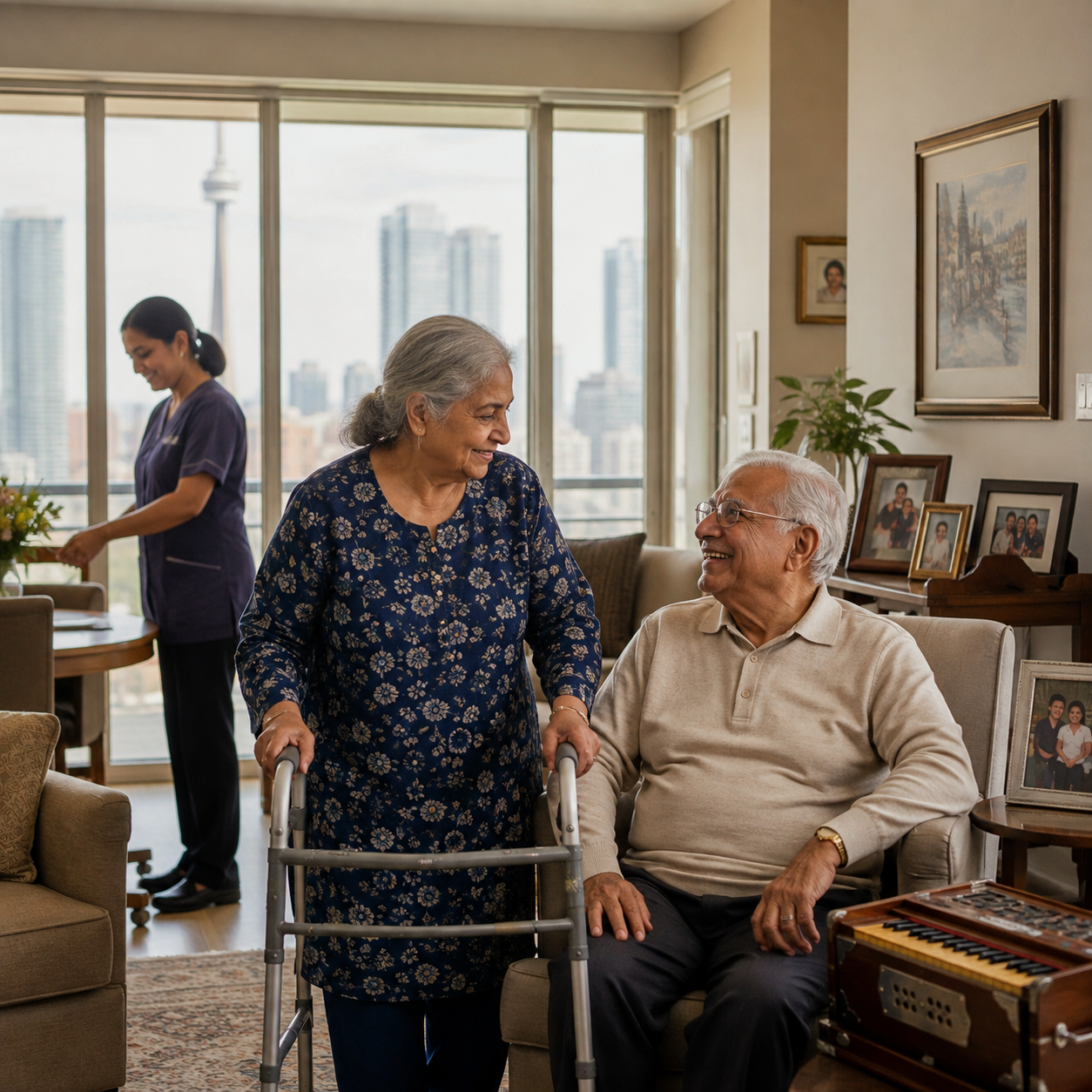
We experienced the family home, downsizing, condominium living, PSW support, Alzheimer's disease, rehabilitation, long term care and the enormous responsibility placed on family caregivers.
It changed the way I think about aging in place, downsizing and senior real estate in Toronto.
What does aging in place really mean?
Aging in place generally means continuing to live as safely and independently as possible in your home or community as you grow older.
But I think families need to broaden their definition of "home."
For one Toronto senior, aging in place may mean remaining in the detached or semi detached house they have owned for forty years.
For another, it may mean selling that house and moving into a condominium with no internal stairs, less maintenance and easier access to care.
Another family may consider multigenerational living.
Someone else may eventually require a retirement residence or long term care.
The address can change while the objective remains the same.
The real objective is preserving as much independence, dignity, familiarity, safety, control and quality of life as circumstances allow.
Aging in place should not mean preserving one particular property at all costs.
Sometimes changing the property is precisely what allows a senior to remain independent longer.
Why aging in place is personal to me
My father was 86 and my mother was 85 when our family had to seriously reassess their housing situation.
My mother was initially dealing with delirium and dementia. Her condition later progressed to late stage Alzheimer's disease.
The house that had served my parents well for many years was becoming less practical.
I started looking at the situation differently.
Were the stairs still safe?
Could they enter and leave the home easily?
How much maintenance did the property require?
What happened during Toronto winters when snow and ice made exterior access more difficult?
What would happen if either of them lost additional mobility?
Could a personal support worker get into the home reliably?
Could a nurse provide care there?
If an ambulance was required, could emergency responders reach them quickly?
Could someone using a walker or wheelchair function in the property?
Were we preserving the house because it was familiar, or were we preserving the lifestyle that was actually best for my parents?
Those are not the same thing.
Eventually, we concluded that it was time to downsize.
We sold my parents' home and moved them into a condominium.
Why a condo made sense for my parents
The condominium was not simply a smaller property.
It solved practical problems.
There were no internal stairs.
Exterior maintenance was no longer their responsibility.
Elevator access made mobility easier.
They could come and go without continually navigating exterior steps, snow and ice.
There was substantially less property to maintain.
Care providers could reach them more easily.
At that stage of their lives, those considerations mattered much more than having a larger house.
I still consider that move part of their aging in place strategy.
We changed the dwelling so they could preserve greater independence.
That experience taught me an important lesson:
Aging in place does not always mean aging in the same place.
Sometimes downsizing is exactly what makes aging in place possible for longer.
Moving into a condo did not eliminate the challenges
A condo can make aging in place easier.
It does not automatically make aging in place easy.
After my parents moved, we applied for PSW assistance.
Many families still use the old term LHIN. Today, Ontario Health atHome coordinates local home and community care, including personal support, nursing, rehabilitation, community referrals and long term care placement.
Getting care arranged is only the beginning.
The harder question is:
How does the system function every single day?
In our experience, PSWs could become unavailable.
People changed jobs.
Schedules changed.
New workers were introduced.
A caregiver who knew my parents and understood their routine could be replaced by someone they had never met.
For many seniors, that is an inconvenience.
For someone living with dementia or Alzheimer's disease, it can be much more significant.
Continuity of care matters when someone has dementia
A new caregiver represents a new face.
A new voice.
A new routine.
A new person entering someone's private space.
That can be confusing or frightening for someone living with dementia.
The Alzheimer Society explains that changes in caregivers or living arrangements can contribute to agitation for some people living with dementia. It also emphasizes understanding what may be behind a behaviour and maintaining consistency and routine where possible.
That means families need to think beyond:
How many PSW hours are we receiving?
They also need to ask:
Who is actually coming?
How consistent is the schedule?
Does this caregiver know Mom or Dad?
What happens when the regular caregiver is unavailable?
Who covers the gap?
Because if nobody else is available, the answer is often:
The family does.
What happens when the PSW cancels?
Every aging in place plan needs redundancy.
If the scheduled caregiver cannot come, who is Plan B?
An adult child?
A spouse?
Another relative?
A neighbour?
A private caregiver?
A home care agency with backup staff?
Families should know in advance:
• Who can arrive on short notice?
• Who has keys or building access?
• Who understands the senior's routine?
• Who can safely assist with transfers?
• Who can help with toileting?
• Who knows emergency contacts?
• Who can prepare meals?
• Who can stay overnight if necessary?
• Which private care providers have been researched?
• What would private backup care cost?
Aging in place becomes fragile when one cancelled shift can destabilize the entire day.
How do families find additional private help?
Publicly funded care may not cover every hour or every need.
Families may eventually investigate private home care agencies or independent caregivers.
I would want to understand:
• Dementia and Alzheimer's experience
• Background screening
• References
• Training
• Agency insurance where applicable
• Minimum shift requirements
• Hourly rates
• Overnight rates
• Weekend availability
• Backup coverage
• What happens when the regular caregiver calls in sick
• Whether consistent caregivers can be scheduled
• Experience with mobility equipment
• Experience with transfers
• Meal preparation
• Toileting and personal care
• Overnight supervision
• Communication with family members
For someone living with dementia, continuity of care should be part of the selection criteria, not an afterthought.
Ontario Health atHome also has a Family Managed Home Care program for certain eligible patients, which can provide funding that the patient or substitute decision maker uses to purchase approved personal support or nursing services under the care plan. Eligibility and circumstances need to be assessed.
Aging in place is a 24 hour responsibility
A PSW may come for a limited number of hours.
The day still has twenty four.
What happens during the remaining hours?
This becomes increasingly important as mobility or dementia progresses.
Who helps at 2:00 a.m. when the person needs to use the bathroom?
Who responds if they get out of bed confused?
Who assists with a transfer?
Who notices if they fall?
Who knows whether they ate dinner?
Who recognizes that something has changed medically?
Who responds if they become frightened or distressed?
Who is there if they cannot safely return to bed?
Families need to think about overnight care before it becomes an emergency.
The solution may involve family coverage, private overnight assistance, respite, supportive housing or eventually another level of care.
There is no universal answer.
But nighttime cannot be ignored when determining whether aging in place remains feasible.
Walking about, disorientation and nighttime safety
People sometimes use the term "wandering" when discussing dementia.
It can be more useful to think about walking about and ask what may be motivating the person's movement.
They may be looking for someone.
Trying to find the bathroom.
Feeling hungry.
Following an old routine.
Feeling uncomfortable.
Confused about the time of day.
Trying to go somewhere they believe they need to be.
The Alzheimer Society encourages caregivers to look for the reason behind the behaviour rather than assuming the movement itself is the problem.
That creates practical housing questions.
Can the person navigate the hallway safely?
Can they encounter stairs?
Can they accidentally leave the home?
Is the bathroom easy to find?
Is nighttime lighting adequate?
Are there trip hazards?
Is someone available if assistance is needed?
The physical property becomes part of the care plan.
Toileting and transfers can determine whether aging in place remains feasible
Families can underestimate how physically demanding caregiving becomes.
Helping someone prepare a meal is one thing.
Safely moving someone from a sofa to a walker, from a wheelchair to a toilet, into a bathtub or into bed can be very different.
My sister was my parents' primary caregiver.
As my mother's mobility deteriorated, those transfers became increasingly difficult.
Eventually, they were physically unsustainable.
That taught me another important lesson.
The question is not only:
Can Mom remain at home?
It is also:
Can the people supporting Mom safely continue providing the assistance she now requires?
Ontario Health atHome identifies transferring, bathing, dressing and other activities of daily living as areas where personal support services may assist eligible patients.
But formal care does not necessarily cover every need at every hour.
A housing strategy that depends on one family member physically exhausting or injuring themselves is not sustainable.
Meal preparation and groceries are part of aging in place too
Aging in place discussions often focus on bathrooms and stairs.
But somebody still needs to eat.
Who buys groceries?
Who notices when food has spoiled?
Who prepares meals?
Who checks whether the person actually ate?
Can the senior use the stove safely?
Can groceries be delivered?
Who puts everything away?
Are there dietary requirements?
Who notices when appetite changes?
These seemingly ordinary responsibilities become part of the care system.
Ontario Health atHome can also connect people with community resources such as meal delivery, transportation, caregiver support, respite and adult day programs.
Social isolation can make staying home less desirable
Aging in place can preserve familiarity.
It can also create isolation.
A person may technically be safe inside the home while spending most of the day alone.
Their spouse may have died.
Friends may have moved away or passed on.
They may no longer drive.
Mobility may make leaving the house difficult.
Weather may keep them inside.
A PSW arriving to provide personal care does not automatically replace friendship, purpose or community.
Families should ask:
Is this person living independently, or are they simply living alone?
Those are different things.
Adult day programs can provide social and recreational activities, meals, some personal care and respite for caregivers. Ontario Health atHome specifically identifies social connection as an important component of well being.
Aging in place should include community, not just a safe floor plan.
My mother's Alzheimer's disease changed what "home" needed to mean
My mother's dementia eventually progressed to late stage Alzheimer's disease.
That changed the housing conversation again.
A home can be physically accessible and still be emotionally or cognitively difficult for someone living with dementia.
I completed U-First!® dementia care training through the Alzheimer Society of Toronto because I wanted to better understand what someone living with dementia may experience and how the people around them can respond more effectively.
U-First!® teaches participants to understand the person living with dementia, recognize that behaviour changes may have many possible causes and work with the care team to provide individualized support.
One lesson stayed with me.
Do not look only at the behaviour.
Look for what might be causing it.
A person may become distressed, restless, agitated or resistant because they are tired, frightened, confused, uncomfortable, overstimulated, in pain or unable to communicate a need.
I am not a clinician or dementia care provider.
But the training changed how I think about housing.
The environment itself can become part of the care strategy.
Familiarity became part of my mother's care
We learned that familiar sights, sounds and routines could help make my mother's environment more reassuring.
Family photographs.
Favourite music.
Videos of family members.
Familiar television programs when they were calming rather than confusing.
Personal belongings.
Familiar voices.
Favourite songs.
Predictable routines.
These were not simply decorations.
They were connections to the life my mother knew.
At the same time, more stimulation was not always better.
Noise, unfamiliar surroundings or disruptions to routine could sometimes create distress.
So the question became very personal.
What makes this person smile?
Which photograph gets their attention?
Which music do they recognize?
What routine feels normal?
What seems to make them uncomfortable?
What seems to reassure them?
Those questions matter whether someone is living in a detached home, condominium, retirement residence or long term care home.
Dementia changes the real estate checklist
If I were helping a Toronto family evaluate housing for someone living with dementia, I would look beyond bedrooms, bathrooms and square footage.
I would also ask:
• Is the layout simple?
• Can important rooms be found easily?
• Are there unnecessary staircases?
• Is lighting consistent?
• Can background noise be reduced?
• Is there room for caregivers?
• Can familiar possessions be incorporated?
• Is the bathroom easy to access?
• Can the person move through the property safely?
• Can caregivers enter reliably?
• Can emergency responders reach the unit quickly?
• Can mobility equipment be accommodated?
• Can daily routines remain relatively consistent?
A prestigious address does not automatically make a good senior residence.
The best home is the one that functions for the person living there.
Toronto's housing stock creates unique aging in place challenges
Toronto contains exceptional neighbourhoods filled with homes that were never designed around aging.
Think about older detached and semi detached housing in areas such as:
• Rosedale
• Moore Park
• Summerhill
• Forest Hill
• The Annex
• Davisville
• Leaside
• Riverdale
• Leslieville
• The Beaches
• Roncesvalles
• High Park
• Bloor West Village
• The Junction
Many properties rely heavily on stairs.
Bedrooms may be upstairs.
Laundry may be in the basement.
Bathrooms can be small.
Exterior steps may be unavoidable.
Parking may be detached from the house.
Snow and ice can complicate access.
A home that functions beautifully at 65 can become a completely different proposition at 80.
That is why I ask:
Can this particular property realistically support the person's future needs?
My six part Toronto aging in place test
1. Access
Can the senior safely enter and leave the home?
2. One level living
Could sleeping, bathing, eating, laundry and essential daily activities eventually happen without stairs?
3. Caregiving space
Can another person safely assist with bathing, dressing, toileting, transfers and mobility?
4. Maintenance
Who handles snow, landscaping, repairs, utilities and ongoing property management?
5. Care continuity
Who provides care, who coordinates the schedule and who fills the gaps when the planned caregiver is unavailable?
6. Community
Does the senior have meaningful social contact, transportation, nearby services and reasons to engage with the world outside the home?
If one system starts failing, aging in place becomes more difficult.
If several fail together, it is time to reassess the plan.
My father's experience taught me where aging in place can reach its limit
Eventually, my father's mobility deteriorated because of venous issues affecting his legs.
He went into rehabilitation.
We hoped rehabilitation would allow him to return home.
Unfortunately, that did not happen.
After approximately six difficult months, his needs had progressed beyond what our family could reasonably manage within a private home environment.
He was transferred into long term care.
That transition taught me something else.
Home is not only a building.
My father loved music.
We brought his accordion.
We brought his harmonium.
We surrounded him with family photographs and reminders of the artwork he had created.
Those things could not turn a long term care room into his former home.
But they brought pieces of his identity with him.
My father passed away in September 2025 after approximately a year in long term care.
We had tried to preserve his independence through several stages.
The family home.
A more practical condo.
Rehabilitation.
Long term care.
I do not view that as aging in place failing.
I view it as:
The appropriate place changed as the person changed.
Then we faced the same decision with my mother
Several months after my father died, my mother's mobility deteriorated significantly.
My sister had carried much of the responsibility as my parents' primary caregiver.
Eventually, helping my mother move from the couch to her walker or wheelchair, helping her use the bathroom, helping her bathe and helping her get into bed became increasingly difficult.
Her Alzheimer's disease added another layer of complexity.
Eventually, we had to ask:
What environment can now safely provide the level of care Mom needs?
We moved her into long term care.
Again, we brought familiar things with her.
Family photographs.
Personal possessions.
Objects she recognized.
Visual reminders of the people and life she knew.
The address changed.
The objective did not.
Safety.
Dignity.
Familiarity.
Comfort.
Caregiver capacity belongs in every aging in place plan
Families often focus entirely on the senior.
They also need to assess the caregiver.
Ask:
• Who is coordinating PSWs?
• Who handles cancellations?
• Who fills gaps?
• Who buys groceries?
• Who prepares meals?
• Who manages appointments?
• Who stays overnight?
• Who responds to emergencies?
• Who assists with toileting and transfers?
• Who manages paperwork?
• Who communicates with doctors?
• Who monitors changes in dementia?
And then ask the uncomfortable question:
How long can that person realistically keep doing all of this?
Caregiver burnout should not be the mechanism holding an aging in place strategy together.
My strongest advice is to have a Plan B
Aging in place can work very well.
Until it does not.
The worst time to develop the next plan is during:
• Hospitalization
• Rehabilitation
• A fall
• Sudden mobility loss
• Dementia progression
• Caregiver burnout
• Loss of PSW coverage
• Long term care placement
• The death of a spouse
That is when families begin making rushed decisions.
A proper Plan B should already consider:
• What the home is worth
• What renovations may be required
• What additional care may cost
• Which accessible housing alternatives exist
• Who will provide backup care
• What will happen overnight
• Who will manage financial decisions
• Who will make personal care decisions if capacity changes
• What belongings should eventually go to family
• What happens if the home needs to be sold
Planning is not giving up.
Planning preserves choices.
Powers of Attorney belong in the aging in place conversation
One of the most important parts of Plan B has nothing to do with stairs, grab bars or real estate values.
It is legal authority.
Many families assume that if Mom or Dad develops Alzheimer's disease, dementia, suffers a stroke or otherwise becomes unable to manage important decisions, an adult child or spouse can simply step in.
In Ontario, that is not necessarily the case.
Ontario recognizes two important types of Power of Attorney:
A Continuing Power of Attorney for Property
and
A Power of Attorney for Personal Care.
They do different jobs.
A dementia diagnosis does not automatically eliminate legal capacity
This distinction matters.
A diagnosis of dementia or Alzheimer's disease does not automatically mean someone is legally incapable of making every decision.
Ontario law presumes adults are capable unless incapacity is established, and a person may be capable of making one type of decision while being incapable of another. Capacity can also change over time.
That is why families should not simply decide among themselves that a parent "cannot make decisions anymore."
Capacity is a legal concept.
Where capacity is uncertain or disputed, appropriate legal and professional advice may be required.
But there is another important lesson:
Do not wait until capacity has already been lost to start thinking about Powers of Attorney.
A person needs the required legal capacity when they create the Power of Attorney.
Planning early allows the individual to choose who they trust rather than potentially leaving that decision to a guardianship process later.
What does a Continuing Power of Attorney for Property do?
A Continuing Power of Attorney for Property can give a trusted person authority to deal with financial and property matters, subject to the wording and restrictions in the document.
Ontario specifically identifies responsibilities such as:
• Paying bills
• Collecting money owed
• Managing investments
• Maintaining a house
• Selling a house
That last point can become critical in a senior housing transition.
Suppose a parent eventually moves into long term care and the Toronto home needs to be sold.
Someone needs the legal authority to sign the necessary documents and deal with the owner's property.
An adult child does not automatically receive that authority because they are the son or daughter.
Even a spouse does not automatically receive full financial decision making authority simply because their partner has become incapable. Ontario specifically warns families about this.
This is something I believe families should understand before a crisis occurs.
What does a Power of Attorney for Personal Care do?
A Power of Attorney for Personal Care addresses a different category of decisions.
Ontario identifies personal care decisions as including areas such as:
• Health care
• Housing
• Meals
• Clothing
• Safety
• Hygiene
A Power of Attorney for Personal Care does not by itself give someone authority to sell the person's house.
That generally falls on the property side.
A family could therefore have someone authorized to participate in personal care decisions but still have a separate legal problem if nobody has authority over the person's finances or real estate.
This is why both documents deserve attention as part of senior planning.
What happens if there is no Continuing Power of Attorney for Property?
This is where the situation can become considerably more complicated.
The first thing families should know is that the Office of the Public Guardian and Trustee does not automatically take over every time someone becomes incapable and has no Power of Attorney.
What happens depends on the individual's circumstances.
Ontario explains that family members may need to pursue additional legal steps, potentially including guardianship.
In certain circumstances, following the applicable incapacity process, the Office of the Public Guardian and Trustee, or OPGT, can become the person's statutory guardian of property.
A private guardian of property may also be appointed through the Ontario Superior Court of Justice.
That is a very different position from having a properly prepared Power of Attorney in place while the person was capable.
What does a guardian of property control?
A guardian of property manages financial property belonging to the incapable person.
Ontario states that this can include:
• Real estate
• Bank accounts
• Income
• Benefits
• Bills and expenses
A guardian has legal duties when managing those assets.
The guardian must manage the incapable person's property in accordance with Ontario law and must keep records of transactions involving the property.
This means that if an incapable person's Toronto home is sold while a guardian is acting, the incapable person's share of the proceeds remains that person's money.
It does not become money for the adult children to divide or manage however they choose.
It remains part of the incapable person's property and is managed for that person's benefit.
That money may ultimately be needed for things such as:
• Housing
• Long term care
• Personal expenses
• Clothing
• Transportation
• Health related needs
• Other expenses for the person's benefit
If the property is jointly owned, legal advice becomes particularly important because the incapable owner may own only part of the property.
A real estate lawyer should review title, ownership, signing authority and the relevant substitute decision making documentation before a property is listed or sold.
Can an adult child replace the Public Guardian and Trustee?
Potentially, in certain statutory guardianship circumstances.
Ontario law permits a spouse, partner or relative to apply to replace the Public Guardian and Trustee when the OPGT is already acting as the person's statutory guardian of property.
But this is not simply a form where someone writes, "I am the daughter" or "I am the son."
The application must be made in the prescribed form.
A Management Plan for the incapable person's property must accompany the application.
The OPGT must be satisfied that the applicant is suitable to manage the property and that the proposed management plan is appropriate.
The OPGT can also impose conditions and, in certain circumstances, require security.
Depending on the situation, a family member may instead need to apply to the Ontario Superior Court of Justice to become guardian of property.
That can involve legal advice, documentation, evidence concerning capacity and a court process.
This can all be occurring at exactly the same time the family is trying to manage:
A parent in hospital.
Rehabilitation.
Long term care.
PSWs.
Bills.
A house.
Possessions.
And potentially a property sale.
That is why I believe legal planning belongs in the aging in place conversation before it is urgently needed.
A Power of Attorney is not the same thing as an executor
There is another distinction families should understand.
A Power of Attorney applies while the person is alive.
Ontario confirms that a Power of Attorney ends when the person dies.
After death, authority over the estate belongs to the appropriate estate trustee or executor and is governed through the estate administration process.
Those are separate legal roles.
That means families should not confuse:
Power of Attorney planning while a parent is alive
with
Will, executor and estate planning after death.
Both matter, but they solve different problems.
Why Powers of Attorney matter to real estate planning
Imagine that a parent has entered long term care.
Their house is sitting vacant.
Property taxes continue.
Utilities continue.
Insurance requirements may change.
Snow removal and maintenance continue.
The family believes selling is the sensible decision.
Then they discover nobody has the authority to sign.
That can fundamentally change the timeline.
This is why one of my Plan B questions for a senior homeowner or adult child is:
If this property eventually needs to be sold and the homeowner cannot make the decision themselves, who has legal authority to act?
That question should be answered while there is still time to address it properly with an Ontario lawyer.
Having Powers of Attorney in place does not mean someone is giving up control.
It can mean exactly the opposite.
It allows a capable person to choose who they trust and provide instructions about how they want future decisions handled.
Do not wait until a crisis to deal with the house
One of the hardest parts of a senior transition is often everything inside the home.
Forty years of photographs.
Furniture.
Books.
Artwork.
Clothing.
Dishes.
Documents.
Jewellery.
Cultural or religious items.
Family keepsakes.
Those decisions should not have to be made in one frantic week because a parent suddenly cannot return home.
Families can start gradually.
Digitize photographs.
Identify important documents.
Ask who wants particular family items.
Create an inventory of valuables.
Donate things nobody needs.
Dispose of items that no longer serve a purpose.
Let the senior participate in those decisions for as long as they are able and want to.
You are not preparing someone to die.
You are reducing chaos if life changes unexpectedly.
Avoid a forced or rushed Toronto home sale
If a parent enters rehabilitation or long term care before the family has thought about the real estate, suddenly everyone starts asking:
What is the house worth?
How quickly can we sell it?
Who has authority to sign?
What repairs are required?
What do we do with everything inside?
How will care be funded?
That is not the ideal time to be negotiating the sale of what may be the family's largest financial asset.
I would rather understand the property early.
That preserves time.
Negotiating leverage.
Choice.
And dignity.
It reduces the risk of effectively fire selling a Toronto property because circumstances have taken control of the timeline.
Know what the Toronto home is worth before making the decision
For many Toronto seniors, the family home is their largest financial asset.
Knowing its approximate value does not mean deciding to sell.
It means understanding the options that property creates.
That is why I created my Shenstimate Toronto home valuation tool.
It provides a preliminary estimate based on recent market data and comparable properties.
For an important senior housing, downsizing or estate decision, I would then review the property personally.
Toronto home values can differ substantially based on:
• Lot size
• Street location
• Parking
• Renovations
• Condition
• Layout
• Property type
• Recent comparable sales
• Micro neighbourhood demand
The important question is not simply:
What is the house worth?
It is:
What choices can this home equity create for the senior?
Aging in place versus downsizing in Toronto
Neither option is automatically cheaper.
Staying may involve:
• Accessibility renovations
• Property taxes
• Utilities
• Insurance
• Maintenance
• Major capital repairs
• Home care
• Private caregivers
• Overnight care
• Snow removal
• Landscaping
Moving may involve:
• Preparing the home for sale
• Selling costs
• Legal fees
• Moving costs
• Replacement housing
• Ontario Land Transfer Tax when applicable
• Toronto Municipal Land Transfer Tax when buying within Toronto
• Condo fees
• New furnishings or renovations
The correct question is:
Which option produces the strongest combination of independence, safety, quality of life and financial sustainability over the next five to ten years?
Can government programs help a Toronto senior remain at home?
Potentially.
For the 2026 tax year, the City of Toronto offers Property Tax, Water and Solid Waste Relief programs for eligible low income seniors and eligible people living with disabilities.
The current 2026 application deadline is November 2, 2026, and applicants must satisfy the applicable eligibility criteria.
The federal Home Accessibility Tax Credit can also apply to qualifying renovations designed to improve accessibility, functionality or reduce the risk of harm for a qualifying individual.
Current federal rules allow up to $20,000 per year in eligible expenses, subject to the program requirements. Seniors age 65 and older can be qualifying individuals.
Families considering qualifying multigenerational living arrangements may also investigate the Multigenerational Home Renovation Tax Credit.
Current rules allow up to $50,000 in qualifying expenditures for an eligible renovation creating a self contained secondary unit for a qualifying senior or eligible adult with a disability to live with a qualifying relative. The actual credit and eligibility depend on the applicable tax year and CRA rules.
I would never build a housing plan around an assumed tax credit or government program without confirming current eligibility with the relevant agency and appropriate tax professional.
When is aging in place no longer feasible?
There is no universal age.
I would reassess the strategy when several factors begin occurring together:
• Falls become a concern
• Stairs become unsafe
• Toileting requires substantial assistance
• Transfers become difficult
• Overnight supervision becomes necessary
• Dementia creates new safety concerns
• Care coverage becomes difficult to maintain
• Caregiver demands become unsustainable
• The senior cannot leave the home safely
• Social isolation increases
• Meal preparation becomes unreliable
• Most of the home is no longer being used
• Major renovations are required simply to accomplish daily activities
• The home cannot accommodate the required level of care
At that point, the question should not be:
How do we keep this person in this house?
It should be:
What living environment gives this person the greatest combination of safety, dignity, familiarity and quality of life now?
What should adult children do before their parents need to move?
I would want the family to answer these questions:
- Is the home safe today?
- Can essential daily living eventually happen without stairs?
- What renovations might be required?
- How much could those renovations cost?
- Who will maintain the property?
- What happens if PSW or nursing assistance becomes necessary?
- Who fills gaps when formal care is unavailable?
- What happens overnight?
- Can caregivers and emergency responders access the home easily?
- Is the senior becoming socially isolated?
- What is the property realistically worth?
- What appropriate replacement housing exists?
- Has a Continuing Power of Attorney for Property been addressed?
- Has a Power of Attorney for Personal Care been addressed?
- Who has authority if the homeowner eventually cannot manage their property?
- What is Plan B if staying home suddenly stops being feasible?
If several of those answers are unknown, the family probably does not yet have a complete aging in place plan.
What if my parents do not want to discuss downsizing?
Do not begin with:
You need to sell your house.
A parent may hear something very different.
Give up your independence.
Give up your memories.
Give up control.
Admit you are getting old.
Instead, start with:
What is becoming difficult?
Maybe the problem can be solved without moving.
Maybe it cannot.
But the homeowner should remain central to the decision wherever they are capable of making it.
My experience with my own parents taught me just how personal this is.
The home is not simply an asset.
It represents decades of someone's life.
That deserves respect.
Frequently asked questions about aging in place in Toronto
What happens if a PSW cancels?
Families should have a backup plan before a cancellation occurs. That might involve another family member, a private caregiver, agency backup coverage or other community support. A single missed visit should not be allowed to place the senior in an unsafe situation.
Why can changing caregivers be difficult for someone with dementia?
Familiarity and predictable routines can be particularly important for people living with dementia. Changes in caregivers or surroundings may contribute to confusion or agitation for some people.
Who looks after a senior overnight?
That depends on the person's needs. Family members, private overnight caregivers, respite or another housing arrangement may eventually be necessary. Frequent nighttime supervision can also be a signal that the sustainability of aging in place needs to be reassessed.
How do seniors avoid becoming isolated at home?
Physical care is only part of the plan. Adult day programs, community programs, transportation, family visits and meaningful activities can support social connection.
Is a condo better than a house for aging in place?
It can be when it eliminates internal stairs and exterior maintenance, but the building and unit still need appropriate access, reliable elevators, caregiver entry, bathroom functionality and emergency access.
Does Alzheimer's disease automatically mean my parent cannot make decisions?
No. Ontario presumes adults are capable unless incapacity is established. Capacity is decision specific, and a person may be capable of some decisions but not others.
Can I sell my parent's house because I am their child?
Not automatically. The person signing and making property decisions needs the appropriate legal authority. A Continuing Power of Attorney for Property may provide that authority, or a guardian of property may be required depending on the circumstances. An Ontario real estate or capacity lawyer should confirm authority before a sale.
What happens if my parent becomes incapable and there is no Power of Attorney for Property?
The answer depends on the circumstances. Family members do not automatically receive financial authority. Guardianship or another substitute decision making process may be required, and the OPGT may become involved in certain situations as a last resort.
Does a Power of Attorney continue after someone dies?
No. Ontario states that Powers of Attorney end when the person dies. Estate administration then falls to the appropriate estate trustee or executor.
How can I avoid having to sell my parents' Toronto home quickly?
Understand the approximate value of the property early, organize important documents and belongings, investigate future housing options, address Powers of Attorney while capacity permits, identify backup caregiving options and create a Plan B before a crisis occurs.
My role as a Toronto Seniors Real Estate Specialist
I hold the Seniors Real Estate Specialist, SRES, designation, and I have completed U-First!® dementia care training through the Alzheimer Society of Toronto.
Neither makes me a physician, occupational therapist, dementia care provider, lawyer, accountant or financial planner.
But that training, combined with my family's lived experience, gives me a much deeper understanding of how aging, Alzheimer's disease, dementia, mobility loss, caregiving and real estate can intersect.
I have lived through:
Selling my parents' home.
Moving them into a condo.
PSW scheduling.
Changing caregivers.
Rehabilitation.
Caregiver strain.
Long term care.
My mother's Alzheimer's disease.
My father's declining mobility.
And ultimately losing my father.
That is why my first question is not:
How do I sell this house?
It is:
What housing decision best serves this person and this family?
Sometimes the answer will be to sell.
Sometimes it will be to stay.
Sometimes it will be to renovate.
Sometimes it will be to move into a condominium.
Sometimes it will be to bring in more support.
Sometimes the care needs will eventually exceed what any private home can realistically provide.
My role is to help the family understand the real estate component of those decisions objectively, and to recognize when legal, medical, tax, financial or care professionals need to become involved.
The lesson my family learned
I believe in aging in place.
But I no longer romanticize it.
Aging in place requires more than a safe house.
It requires:
A suitable property.
Reliable care.
Backup care.
Meals.
Groceries.
Toileting.
Mobility assistance.
Nighttime planning.
Social contact.
Caregiver capacity.
Legal planning.
Financial planning.
And eventually, a Plan B.
My parents' journey went from their family home to a more practical condominium, to increasing home support, rehabilitation and ultimately long term care.
At every stage, our goal was to make the environment feel like their home, not simply somewhere they had been placed.
For my father, that meant his accordion, his harmonium, family photographs and reminders of the artwork he created.
For my mother, it has meant familiar photographs, possessions, music, voices and reminders of the family and life she knows.
That experience taught me that the strongest senior housing strategy has two parts:
Plan A: Help the person remain as independent as reasonably possible.
Plan B: Know what you will do if Plan A no longer works.
Having a Plan B does not mean expecting the worst.
It means preserving choices.
You can understand what the Toronto home is worth before you need to sell it.
You can address Powers of Attorney while the homeowner is still capable of making those decisions.
You can organize possessions thoughtfully instead of dealing with decades of memories under pressure.
You can investigate accessible condos, retirement residences, community programs, private care and long term care before circumstances force the conversation.
You can identify who will provide backup care.
You can understand the financial implications.
Most importantly, the senior can participate in those decisions for as long as possible.
If you are a Toronto senior trying to determine whether your home can support you through the next stage of life, or an adult child asking the same question about your parents, I can help you analyze the real estate side of that decision before a crisis takes control of the timeline.
Sometimes staying will be the right answer.
Sometimes moving will be.
The advantage is knowing the difference while you still have choices.
This article provides general real estate and housing information and reflects both my professional perspective and personal family experience. It is not medical, legal, tax, financial or capacity advice. Powers of Attorney, guardianship and substitute decision making are fact specific legal matters. Government programs, tax credits, care services, regulations, funding and eligibility requirements can change. Obtain advice from an appropriate Ontario lawyer and other qualified professionals regarding your individual circumstances.

Related Insights

.svg)
.avif)

.svg)
A Local Agent You Can Trust
I do more than just buy and sell properties — I guide families through complex transitions with care, patience, and full hands-on support. From staging and preparations to move-in day, I’m here to handle every detail so you can focus on what matters most.