.svg)
Downsizing in Toronto: A Guide for Seniors and Families Planning the Right Move
A practical Toronto seniors downsizing guide covering home equity, condo choices, costs, Powers of Attorney, decluttering and planning a move before a crisis.
.svg)

.svg)
.svg)
Short answer: Downsizing in Toronto can release substantial home equity and simplify daily life, but it should not be treated as simply selling a large house and buying a smaller condo.
For a senior homeowner, the better question is:
What housing decision gives me the strongest combination of independence, financial security, accessibility, community and quality of life for the next stage of my life?
That answer may be a condo.
It may be a bungalow.
It may be a smaller home closer to family.
It may be a retirement residence.
And sometimes the analysis shows that moving is unnecessary and aging in place remains the better decision.
My own family went through this process with my parents.
That experience taught me that the best time to plan a Toronto downsize is before health, mobility or caregiving circumstances force the decision.
What does downsizing mean for a Toronto senior?
Downsizing is often described as moving from a larger home into a smaller one.
I think that definition is incomplete.
For a senior, downsizing should really mean rightsizing the home for the life you want to live next.
That may involve:
• Fewer stairs
• Less maintenance
• Better accessibility
• Easier access to transportation
• Proximity to doctors and pharmacies
• Being closer to children or grandchildren
• Releasing home equity
• Reducing property responsibilities
• Improving access for PSWs or caregivers
• Creating a safer environment
• Having more opportunities for social connection
A successful downsize should solve a problem.
If moving into a smaller property does not improve the homeowner's life, the fact that it has fewer square feet does not make it a successful downsize.
Why downsizing is personal to me
My father was 86 and my mother was 85 when our family had to reconsider whether their existing home remained practical.
My mother's health was changing and her dementia eventually progressed to late stage Alzheimer's disease.
We had to look beyond the emotional attachment to the family home.
Were the stairs still appropriate?
Was exterior maintenance becoming unnecessary responsibility?
Could they come and go safely?
What would happen as their mobility declined?
Could PSWs and other caregivers access them easily?
Could an ambulance reach them quickly?
Would a different housing environment allow them to remain independent longer?
Our conclusion was that downsizing made sense.
We sold their home and moved them into a condominium.
The condo gave them something more valuable than additional square footage.
It gave them simplicity.
No internal stairs.
Elevator access.
Less maintenance.
Less exposure to exterior steps, snow and ice.
Better practicality as caregiving needs increased.
That experience fundamentally changed the way I think about downsizing.
I do not see it primarily as a real estate transaction.
I see it as a housing transition that should support the next stage of someone's life.
Should I downsize my Toronto home?
I would not answer that question based on age.
I would start by asking:
What problem are we trying to solve?
Is the issue:
• Stairs?
• Property maintenance?
• Mobility?
• Loneliness?
• Transportation?
• A spouse who has passed away?
• Too much unused space?
• A desire to travel?
• Increasing caregiving needs?
• A need to release home equity?
• Being too far from family?
• Concern about what happens during a future health crisis?
Those are different problems.
Some can be solved without selling.
Others may strongly support a move.
Before someone puts a Toronto home on the market, I want to understand why they are moving and what the replacement property needs to accomplish.
Start by finding out what the Toronto home is worth
For many Toronto seniors, their home is the largest financial asset they own.
Some purchased decades ago at prices that bear little resemblance to today's market value.
Before making a major housing decision, I want to establish:
What could this property realistically sell for today?
That is why I created my Shenstimate Toronto home valuation tool.
It provides an initial estimate using recent market data and comparable sales.
An automated valuation is only a starting point.
Older Toronto houses can vary substantially based on:
• Street
• Lot size
• Parking
• Renovations
• Condition
• Layout
• Property type
• School catchment
• Recent comparable sales
• Micro neighbourhood demand
For a significant downsizing or estate decision, I would then review the home personally and determine whether the automated estimate reflects what the market is likely to support.
Knowing the home's value does not mean the owner has decided to sell.
It means the family can finally start comparing real options.
How much money will I actually release by downsizing?
This is one of the most important questions in a Toronto downsizing decision.
Suppose a homeowner believes:
My house is worth $1,500,000.
They are considering purchasing a condo for:
$900,000.
It is tempting to calculate:
$1,500,000 minus $900,000 = $600,000
and assume $600,000 will be released.
That is not the real number.
The proper calculation needs to consider:
Expected sale proceeds
minus
Any mortgage or secured debt
minus
Selling and legal costs
minus
Cost of replacement housing
minus
Land transfer taxes
minus
Moving expenses
minus
Renovations or furnishings
equals
Approximate capital released
The actual result can be materially different from the simple difference between two property prices.
That is why I prefer to build the downsizing numbers before the house goes up for sale.
Do Toronto downsizers pay land transfer tax?
Selling a home does not trigger Ontario or Toronto land transfer tax for the seller.
But if the homeowner purchases another property, land transfer tax generally applies to the new purchase.
If the replacement home is inside the City of Toronto, the buyer generally pays both:
and
Toronto Municipal Land Transfer Tax
For example, on a hypothetical $900,000 Toronto residential purchase, the Ontario land transfer tax under current rates is approximately $14,475.
Toronto's municipal land transfer tax on the same purchase is also approximately $14,475.
That means approximately:
$28,950 in combined land transfer taxes
before legal fees, moving costs, furnishings or other transaction expenses.
Toronto's municipal land transfer tax applies in addition to Ontario's land transfer tax. Current Toronto rates should always be checked when planning a move because municipal tax rules can change.
This is why the financial analysis should be completed before assuming that downsizing automatically releases a particular amount of cash.
What does the 2026 Toronto market mean for downsizers?
The 2026 market deserves more nuance than simply saying houses are strong and condos are weak.
Toronto is not one market.
Different property types and neighbourhoods can behave very differently.
As of the second quarter of 2026, TRREB reported 8,061 active condominium apartment listings across the GTA at quarter end, down 15.4 per cent from the previous year.
The average City of Toronto condominium apartment selling price during Q2 2026 was $667,916, down from $717,403 during Q2 2025.
TRREB described condo buyers as continuing to benefit from ample choice and negotiating power, even though inventory had tightened compared with the previous year.
By August 2026, conditions across the broader GTA were also tightening. TRREB reported 5,057 sales, while new listings fell 14.1 per cent compared with August 2025. The overall GTA average selling price was $993,410, down 2.7 per cent year over year.
For some Toronto downsizers, this can create an interesting situation.
A long held freehold home may attract a very different buyer pool from the condominium the owner intends to purchase.
That can potentially create negotiating opportunities on the replacement property.
But I would never assume that every detached home will sell strongly or every condo seller will negotiate.
The opportunity needs to be evaluated property by property.
Should I sell first or buy the condo first?
This is one of the most consequential downsizing decisions.
There is no universal answer.
Selling first can provide certainty.
The homeowner knows:
• What the existing property actually sold for
• How much equity is available
• What budget exists for the replacement property
• What closing date needs to be coordinated
Buying first can provide greater housing certainty.
The homeowner knows exactly where they are moving and may avoid the pressure of searching for replacement housing after accepting an offer.
But it can also create financing, timing and carrying cost considerations if the current property has not sold.
The right approach depends on:
• Financial capacity
• Mortgage requirements
• Market conditions
• How replaceable the target property is
• Desired neighbourhood
• Closing flexibility
• Whether temporary accommodation is acceptable
• The homeowner's tolerance for uncertainty
For many seniors, minimizing uncertainty is worth more than trying to perfectly time both markets.
Do I need to buy another property at all?
Not necessarily.
Downsizing does not automatically mean selling one home and purchasing another.
The next stage might involve:
• Buying a condo
• Renting a condo
• Buying a bungalow
• Moving into a 55 plus community
• Life lease housing
• A retirement residence
• Multigenerational living
• Moving closer to family
Each produces a very different financial outcome.
Someone who sells a Toronto home for a significant amount and rents rather than buys may release considerably more capital, but now has ongoing rent and less control over future housing costs.
Someone buying a condo retains real estate ownership but ties a large amount of capital into the replacement property.
Neither is automatically right.
The objective is to understand what the homeowner values most:
Ownership, liquidity, simplicity, predictability, care access or lifestyle.
Is selling my principal residence tax free?
For many Canadian homeowners, the gain on the sale of a principal residence can qualify for the principal residence exemption if the property meets the applicable CRA requirements.
However, the sale still needs to be reported on the owner's income tax return.
The CRA states that individuals generally must report the disposition and designate the property as their principal residence to claim the exemption. Different rules can apply where the property was rented, partly income producing, not the principal residence for all years, or where other circumstances exist.
I would have an accountant or tax professional review any uncertainty before relying on an assumed tax result.
Will selling my home trigger the OAS clawback?
Not simply because the homeowner receives the proceeds from selling a qualifying principal residence.
This is an important distinction.
If the gain is fully sheltered by the principal residence exemption, receiving the sale proceeds is not the same thing as earning that amount as taxable income.
However, what happens after the sale can matter.
Suppose a homeowner releases several hundred thousand dollars and invests the money.
Future taxable:
• Interest
• Dividends
• Capital gains
• Pension income
• Other taxable income
can affect the person's net income and potentially their Old Age Security recovery tax.
For the 2026 income year, the minimum OAS recovery threshold is $95,323. That income year is used for the July 2027 to June 2028 recovery period.
That does not mean a senior should avoid downsizing because of OAS.
It means the investment and income strategy for released equity should be discussed with an appropriate accountant or financial planner.
Real estate creates the capital.
The financial plan determines what happens next.
Condo fees matter more than the purchase price alone
A homeowner may sell a large house and feel that moving into a condo dramatically reduces housing costs.
Sometimes it does.
But the analysis should include the monthly condominium fee.
I would examine:
• Current maintenance fee
• What utilities are included
• Parking costs
• Locker costs
• Building insurance responsibilities
• Reserve fund
• Upcoming major projects
• History of fee increases
• Special assessments
• Age and condition of building systems
• Property taxes
A $750,000 condo with a substantial monthly fee may produce a different retirement budget from a $850,000 unit with a lower fee structure.
Purchase price alone does not determine affordability.
What should a Toronto senior look for in a condo?
My own parents' transition taught me to look at condominiums differently.
For a senior, I would pay close attention to:
• Step free building entrance
• Elevator reliability
• Distance from elevator to unit
• Number of elevators serving the building
• Parking location
• Walker and wheelchair accessibility
• Bathroom layout
• Shower thresholds
• Laundry access
• Space around the bed
• Door widths
• Balcony thresholds
• Lighting
• Concierge or entry system
• PSW and caregiver access
• Emergency responder access
• Grocery stores
• Pharmacy
• Medical services
• Transit
• Family proximity
A beautiful view does not compensate for a layout that becomes difficult to navigate.
The correct condo is one that can continue working as the homeowner's needs change.
Is downsizing the same thing as aging in place?
They can be part of the same strategy.
My parents left their house and moved into a condo.
I still consider that part of aging in place.
The objective was not to keep them inside one particular building.
The objective was to allow them to maintain as much independence as possible in a more practical environment.
This is why I do not see aging in place and downsizing as opposites.
Sometimes:
Downsizing enables aging in place.
A senior may leave a three storey Toronto house but remain in the same neighbourhood, continue using the same doctors, visit the same shops and remain close to the same friends and family.
The property changes.
The community does not necessarily have to.
How early should seniors start downsizing?
Earlier than most families think.
The best time to make the decision is generally when the homeowner still has:
• Choice
• Mobility
• Time
• Decision making capacity
• Energy
• Family participation
• Negotiating flexibility
The hardest time is often immediately after:
• A fall
• Hospitalization
• Rehabilitation
• Loss of mobility
• A dementia diagnosis progressing
• Death of a spouse
• Caregiver burnout
• A sudden long term care transition
At that point, the family can be handling health care, legal authority, belongings, finances and real estate simultaneously.
That is precisely when people begin rushing.
Why a rushed Toronto home sale can be expensive
A rushed sale does not necessarily mean the property sells dramatically below market value.
But time pressure reduces options.
The family may have less time to:
• Complete repairs
• Declutter
• Improve presentation
• Obtain competing contractor quotes
• Organize belongings
• Review comparable sales
• Choose the best listing date
• Coordinate the replacement housing
• Resolve legal authority
• Negotiate patiently
The homeowner may also have less involvement in the process.
That is why I prefer to build a Plan B before Plan A fails.
Powers of Attorney should be addressed before a crisis
Senior real estate planning is not only about property value.
It is also about who has legal authority to act if the homeowner eventually becomes incapable of managing property decisions.
In Ontario, an adult child does not automatically gain authority to sell a parent's house simply because they are the son or daughter.
A spouse does not automatically receive unrestricted authority over the other spouse's property either.
A Continuing Power of Attorney for Property can authorize a chosen person to manage financial and property matters, subject to the terms of the document.
Ontario specifically identifies maintaining and selling a house among the types of property decisions an attorney may be authorized to make.
A Power of Attorney for Personal Care addresses different decisions, including health care, housing, nutrition, safety and personal care.
The two documents serve different purposes.
If appropriate legal authority is not already in place and the homeowner loses capacity, guardianship or another substitute decision making process may become necessary.
I recommend addressing these questions with an Ontario lawyer before incapacity makes the situation substantially more complicated.
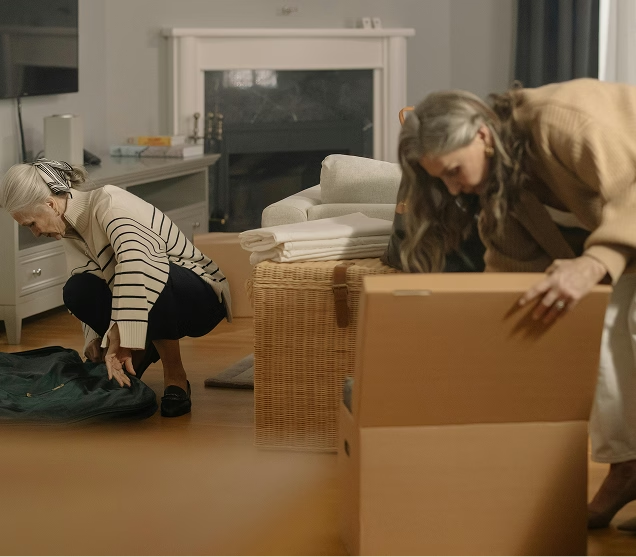
Decluttering is usually harder than selling
A house occupied for thirty, forty or fifty years can contain an extraordinary amount of someone's life.
Furniture.
Photographs.
Artwork.
Books.
China.
Clothing.
Tools.
Documents.
Jewellery.
Family keepsakes.
Items inherited from previous generations.
The mistake is waiting until moving week to decide what happens to everything.
I would start earlier.
Ask:
What is coming to the new home?
What should go to children or grandchildren?
What should be sold?
What should be donated?
What needs professional appraisal?
Which photographs or documents should be digitized?
What does the homeowner absolutely want to keep?
Downsizing possessions gradually can make the eventual property transition considerably less stressful.
Do I need a senior move manager?
Some families manage the entire move themselves.
Others hire senior move managers, organizers, movers, estate sale specialists or other transition professionals.
The right level of help depends on:
• Amount of property contents
• Family availability
• Physical ability
• Time
• Distance between family members
• Complexity of the move
• Whether items need to be sold or donated
• The homeowner's emotional attachment to belongings
I would not quote a generic Toronto price because these services can vary substantially by scope.
Instead, I would obtain detailed written quotes and understand exactly what is included.
The important question is not whether professional assistance is fashionable.
It is whether the additional help meaningfully reduces the physical and emotional burden on the senior and family.
What should adult children do if their parents are considering downsizing?
Do not start with:
You need to sell the house.
Start with:
What is becoming difficult?
Then establish the facts.
What is the house worth?
Get a realistic market estimate.
What does staying cost?
Include maintenance, taxes, utilities, repairs and potential accessibility work.
What would appropriate replacement housing cost?
Use actual available properties, not assumptions.
How much equity would genuinely be released?
Calculate transaction and replacement costs.
What does the parent want?
The homeowner needs to remain central to the decision wherever they are capable of making it. If the decision ultimately involves selling a parent’s long held Toronto home, there are additional legal, logistical and property preparation issues the family should understand before the sale begins.
What happens if nothing changes?
Sometimes this is the most important question.
If the parent remains in the home for another five years, does that improve the situation or simply postpone a transition until it becomes more difficult?
Does downsizing mean giving up independence?
It should not.
Done properly, downsizing can increase independence.
A smaller, better designed dwelling may allow someone to:
• Leave home more easily
• Maintain the property independently
• Access transportation
• See family more often
• Manage fewer repairs
• Use a walker more safely
• Receive care more effectively
• Travel without worrying about a vacant house
• Spend less time managing property
The objective is not shrinking someone's life.
The objective is reducing the housing burden so the person has more freedom to live it.
My Toronto senior downsizing checklist
Before listing a long held Toronto home, I would want answers to these questions:
- Why is the homeowner considering moving?
- What is the current property realistically worth?
- What is the outstanding debt, if any?
- What will selling likely cost?
- What housing option would genuinely improve the homeowner's life?
- What will that replacement housing cost?
- How much capital will actually remain after the move?
- Will the replacement property remain practical if mobility changes?
- Can caregivers and emergency responders access it easily?
- What belongings are moving?
- What happens to everything that is not moving?
- Who has legal signing authority if capacity changes?
- Has tax and financial planning been considered?
- Should the current home be sold before buying the replacement property?
- What is Plan B if health circumstances change during the process?
If several of those questions are unanswered, I would slow the process down.
Frequently asked questions about downsizing in Toronto
When should a senior downsize in Toronto?
There is no correct age. The decision should be based on the functionality of the current home, maintenance burden, finances, mobility, social connection, caregiving requirements and the homeowner's personal objectives.
How much money can I release by downsizing in Toronto?
It depends on the sale price of the existing home, debt, selling costs, the cost of replacement housing, land transfer taxes and moving expenses. The difference between the two property prices is not the same as the amount of capital ultimately released.
Should seniors buy a condo before selling their house?
It depends on finances, market conditions, closing flexibility and the availability of suitable replacement properties. Selling first can create financial certainty, while buying first can create housing certainty.
Does selling a principal residence affect OAS?
The sale proceeds themselves are not automatically income for OAS purposes. A qualifying principal residence may receive the principal residence exemption. However, taxable investment income generated from released equity can affect future net income and potentially OAS recovery tax.
Do I pay tax when I sell my Toronto home?
A property that qualifies fully for the principal residence exemption will generally not have taxable capital gain on the sale, but the disposition must still be reported to the CRA. Individual circumstances can change the result.
What should seniors look for when buying a Toronto condo?
Accessibility, elevators, bathroom layout, parking, caregiver access, emergency access, proximity to groceries and medical services, condo fees, reserve fund health and the overall functionality of the unit should all be considered.
Should I renovate my current home instead of downsizing?
Potentially. Compare the cost and practicality of renovations with the total cost and lifestyle implications of moving. Aging in place and downsizing should be evaluated side by side rather than assuming one is automatically superior.
How can adult children help parents downsize without taking over?
Start with the parent's goals and concerns rather than announcing that the house needs to be sold. Establish the facts about value, costs and housing alternatives, then allow the parent to remain involved in decisions wherever possible.
What if my parent develops dementia before the house is sold?
A dementia diagnosis does not automatically determine legal capacity. If the homeowner becomes incapable of managing property, the person acting on their behalf needs appropriate legal authority. Powers of Attorney and capacity questions should be addressed with an Ontario lawyer.
How do I find out what my parents' Toronto home is worth?
My Shenstimate home valuation tool provides a preliminary estimate using recent market data. For a significant senior downsizing or estate decision, I would then personally review the property, condition, renovations and the most relevant comparable sales.
My role as a Toronto Seniors Real Estate Specialist
I hold the Seniors Real Estate Specialist, SRES, designation.
But my understanding of downsizing also comes from going through the process with my own parents.
I understand that a long held Toronto home is not simply inventory.
It may represent:
A marriage.
Children growing up.
Family celebrations.
A spouse who has passed away.
Decades of neighbours.
Renovations completed together.
Photographs in every room.
Possessions accumulated over a lifetime.
That is why my first objective is not:
How quickly can we list the house?
It is:
What does this family actually need to accomplish?
Once that is clear, I can help with the real estate strategy:
• Establishing market value
• Reviewing comparable sales
• Planning timing
• Evaluating replacement housing
• Comparing the economics of staying versus moving
• Preparing the home for market
• Coordinating the sale with the next housing step
• Identifying where legal, financial, tax or care professionals need to become involved
Sometimes the correct recommendation will be to sell.
Sometimes it will be to wait.
Sometimes a renovation will solve the problem.
Sometimes the condo will solve it.
The important thing is making the decision while there is still enough time to make it properly.
The bottom line
Downsizing in Toronto should not begin with a For Sale sign.
It should begin with a plan.
Know what the home is worth.
Understand why you are considering moving.
Calculate the true cost of the replacement housing.
Determine how much equity the move will actually release.
Think about accessibility five years from now, not simply what works today.
Address Powers of Attorney and legal authority before they are urgently needed.
Start organizing possessions before there is a crisis.
And most importantly, involve the senior in the decision for as long as possible.
My own family's experience taught me that a well planned downsize can preserve independence rather than take it away.
If you are a Toronto senior considering whether your current home still makes sense, or an adult child helping your parents think about what comes next, I can help you establish the home's value, compare the real estate options and build a practical transition plan before circumstances dictate the timeline.
Sometimes the right decision will be to stay.
Sometimes the right decision will be to move.
The advantage comes from knowing the difference while you still have choices.
This article provides general real estate and housing information and reflects both my professional perspective and personal family experience. It is not legal, tax, financial, medical or capacity advice. Real estate markets, tax thresholds, government programs and individual circumstances change. Confirm current requirements with the relevant government agency and appropriate qualified professional before making decisions.

Related Insights

.svg)


.svg)
A Local Agent You Can Trust
I do more than just buy and sell properties — I guide families through complex transitions with care, patience, and full hands-on support. From staging and preparations to move-in day, I’m here to handle every detail so you can focus on what matters most.